

Men and machines are good at different things. People form plans and make decisions in complicated situations. We are less good at making sense of enormous amounts of data. Computers are exactly the opposite: they excel at efficient data processing but struggle to make basic judgments that would be simple for any human.
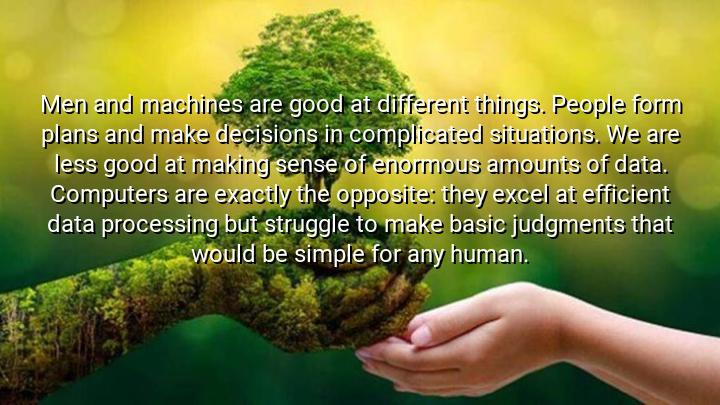




The quote "Men and machines are good at different things. People form plans and make decisions in complicated situations. We are less good at making sense of enormous amounts of data. Computers are exactly the opposite: they excel at efficient data processing but struggle to make basic judgments that would be simple for any human" by Peter Thiel highlights the complementary roles that humans and machines play in solving problems. Thiel, a prominent entrepreneur and venture capitalist, is emphasizing that while humans excel at reasoning, decision-making, and navigating complex, unstructured environments, computers thrive in handling large-scale data processing, performing repetitive tasks, and executing calculations with great efficiency.
Thiel’s quote reflects the ongoing debate in technology and artificial intelligence (AI) about the distinct capabilities of human intelligence and machine learning. Humans are naturally better at making sense of ambiguous situations and applying judgment in uncertain circumstances, but when it comes to processing vast amounts of data or executing tasks with speed and accuracy, computers outperform humans. This distinction draws attention to how AI and machine learning can complement human decision-making, but they cannot replace the intuitive and contextual understanding humans bring to complex problems.
The origin of this quote can be traced to Thiel’s philosophy around technology, innovation, and the future of AI. As a co-founder of PayPal and an advocate for technological disruption, Thiel has often discussed the importance of understanding both the strengths and limitations of new technologies. His quote reflects his belief that, while computers are powerful tools, they should not be viewed as replacements for human creativity and decision-making, but rather as tools that augment human capability in specific areas.
Ultimately, Thiel’s quote serves as a reminder that humans and machines each have their unique strengths, and the future lies in finding ways for them to work together rather than seeing one as a direct substitute for the other. While AI can handle tasks that require precision and the processing of large data sets, human judgment and intuition remain crucial in making sense of the broader context and complex decisions.

AAdministratorAdministrator
Welcome, honored guests. Please leave a comment, we will respond soon