

Literary imagination is an aesthetic object offered by a writer to a lover of books.
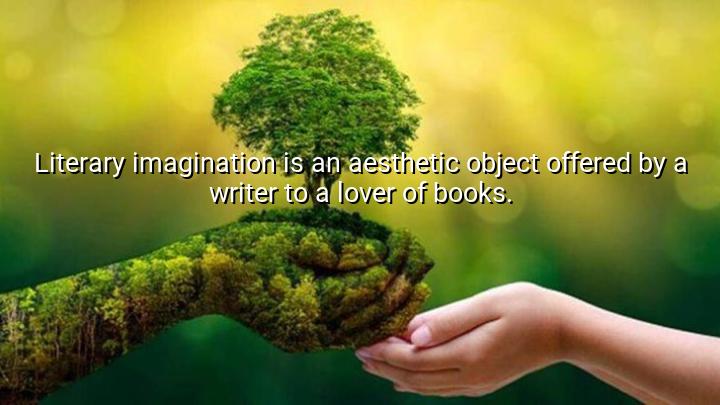




The quote "Literary imagination is an aesthetic object offered by a writer to a lover of books" by Gaston Bachelard suggests that the imagination used in literature is a crafted, artistic creation that a writer presents to the reader, specifically to those who appreciate the beauty and depth of books. Bachelard emphasizes that literature is not just a vehicle for stories or facts, but an aesthetic object—something meant to be experienced and appreciated for its form, style, and emotional impact. The imagination involved in creating literature is something that engages the reader, allowing them to explore new worlds, ideas, and emotions in an artistic way.
The origin of this quote lies in Bachelard's philosophy of imagination and his views on the role of the writer in shaping how we experience the world. As a French philosopher known for his work on the philosophy of science and imagination, Bachelard believed that the imagination was a central element in understanding both the natural world and the realm of human experience. For him, literature is a space where the imagination can manifest in its most vivid and refined forms, offering readers a rich, sensory experience that transcends mere narrative.
Bachelard’s statement also implies that imagination in literature is something that is actively created by the writer for the lover of books, or those who seek more than just plot and facts. The reader is invited to immerse themselves in the aesthetic qualities of the work, such as its language, its atmosphere, and the emotional resonance it creates. Literature, in this sense, is not just functional or informational but is an art form that speaks to the imagination and offers an emotional and intellectual experience.
In essence, Bachelard’s quote underscores the idea that literature is a form of imagination shaped by the writer and appreciated by the reader. It highlights the aesthetic dimension of literature, suggesting that the true value of a book lies not only in its content but in its ability to engage the imagination and offer a deeper, more artistic experience. The writer presents their world of imagination, and in turn, the reader experiences it as an object of beauty, creativity, and emotional depth.

AAdministratorAdministrator
Welcome, honored guests. Please leave a comment, we will respond soon