

It is not that the child lives in a world of imagination, as we wrongly think, but that the imagination lives in the child.
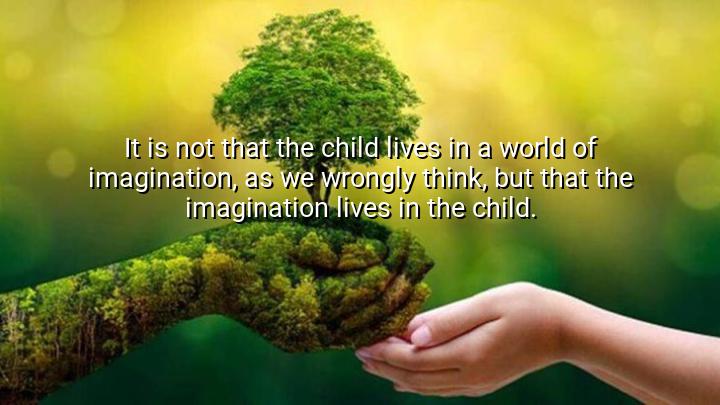




The quote "It is not that the child lives in a world of imagination, as we wrongly think, but that the imagination lives in the child" by Gaston Bachelard challenges the common perception that children merely escape into a world of fantasy. Instead, Bachelard suggests that imagination is an inherent part of the child’s nature, something deeply embedded in their being. Rather than viewing imagination as an external or separate realm that children inhabit, he proposes that imagination is a fundamental aspect of how children perceive and interact with the world around them.
Bachelard’s philosophical perspective emphasizes that imagination is not something children merely use occasionally but rather something that is deeply integrated into their daily lives. It is part of their cognitive and emotional processes, shaping how they experience and make sense of reality. This view aligns with Bachelard’s broader interest in how the human mind creates and interprets imagined worlds, particularly in relation to childhood and creativity.
The quote also suggests that imagination is not a passive or secondary force in children, but an active and vibrant part of their development. Children are not just playing in an imaginary world; they are creating one through their inherent creativity and ability to engage with their surroundings in uniquely imaginative ways. This understanding positions imagination as a dynamic force that shapes how children think, learn, and grow.
Ultimately, Bachelard’s insight encourages a deeper appreciation for the role of imagination in childhood. Rather than seeing it as a temporary or fanciful phase, he advocates for recognizing imagination as a vital, life-defining element of human experience. For Bachelard, the child is not just experiencing imagination—they are living it, embodying its potential for innovation, discovery, and a richer engagement with the world.

AAdministratorAdministrator
Welcome, honored guests. Please leave a comment, we will respond soon