

Land and sea, weakness and decline are great separators, but death is the great divorcer for ever.
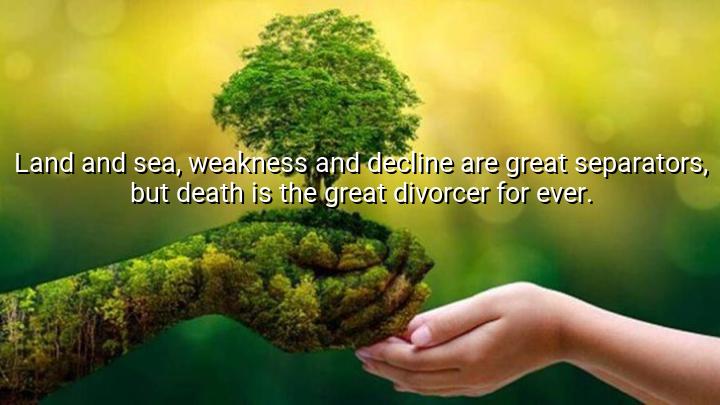




The quote "Land and sea, weakness and decline are great separators, but death is the great divorcer for ever." by John Keats reflects on the ultimate separation that occurs through death. Keats acknowledges that physical distance or the weakness that comes with aging or decline can create divisions between people, but these separations are temporary. In contrast, death represents the final and irreversible division between individuals, severing all connections forever. It is a powerful reminder of the finality and permanence of death.
Keats uses the imagery of land and sea to symbolize physical and emotional distances that can arise in relationships. While these distances can be challenging, they are surmountable with effort or time. Similarly, weakness and decline, such as the effects of aging or illness, can also cause people to grow apart, but they do not carry the same irreversibility as death. Keats points to the idea that while life's challenges may create separations, death is the ultimate force that ends relationships completely and without hope of reconciliation.
The origin of this quote lies in Keats's work during a time of personal struggles, including his own health issues and the loss of loved ones. He experienced the death of his brother and was also deeply aware of his own fragile health, as he would die young at the age of 25. Keats’s contemplation of mortality and the inevitability of death in his writing reflects his awareness of how it separates us not just physically, but emotionally and spiritually from those we care about.
Ultimately, Keats’s quote serves as a reflection on the impermanence of life and the inevitability of death. It highlights how death is the one force that creates an irreversible separation, and while other separations in life may be overcome, death remains the ultimate and final barrier, marking the end of all connections.

AAdministratorAdministrator
Welcome, honored guests. Please leave a comment, we will respond soon