

Just remember, in 1973, we had no digital cameras, no personal computers, no Internet. The thought of putting a billion transistors in a cell phone was ludicrous.
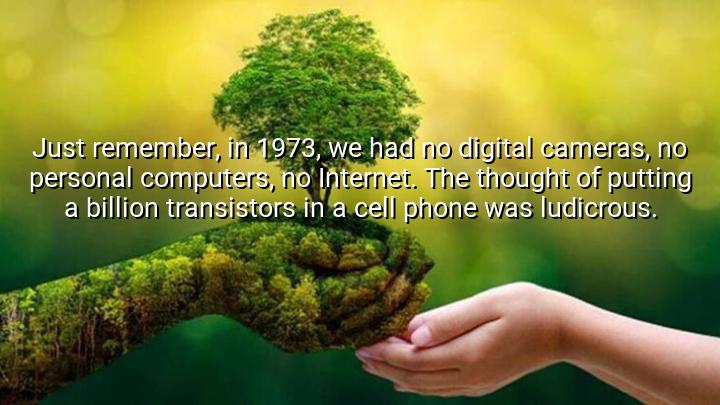




In this quote, Martin Cooper reflects on the rapid evolution of technology by contrasting the state of innovation in 1973 with the advanced capabilities we have today. He points out that in 1973, there were no digital cameras, personal computers, or Internet, highlighting how these technologies, which are now integral to modern life, did not exist or were in their infancy at the time. The mention of the billion transistors in a modern cell phone serves to emphasize just how far technological advancement has come, making ideas that were once considered ludicrous now a reality.
Cooper's statement serves as a reminder of how technology has progressed over the decades, challenging what people thought was possible. At the time, the concept of placing a billion transistors—the tiny electronic components that power modern computers—into a cell phone seemed unimaginable. Today, however, this has become the norm, with smartphones boasting incredible processing power, storage, and functionality, far beyond what anyone could have predicted in 1973.
The origin of this quote can be traced back to Martin Cooper's pioneering work in the field of telecommunications. As the inventor of the mobile phone, Cooper was at the forefront of a technological revolution. His experience in developing the first handheld mobile phone in the early 1970s gives him a unique perspective on the incredible strides that have been made in the tech world, especially in terms of miniaturization and the convergence of various technologies into a single device.
Ultimately, Cooper's quote emphasizes the exponential growth of technology and the importance of innovation in pushing the boundaries of what is possible. It serves as both a reflection on the past and a recognition of how far we've come, showing that what once seemed impossible is now not only achievable but also commonplace.

AAdministratorAdministrator
Welcome, honored guests. Please leave a comment, we will respond soon