

Joy can only be real if people look upon their life as a service and have a definite object in life outside themselves and their personal happiness.
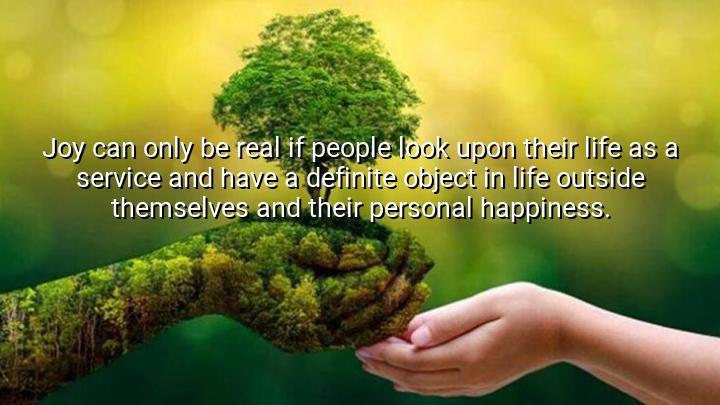




In this quote, Leo Tolstoy suggests that true joy is achieved not through the pursuit of personal happiness or self-centered desires, but through the commitment to service and a higher purpose. Tolstoy believes that when individuals focus solely on their own happiness, they may find temporary pleasure, but it lacks lasting fulfillment. However, when one looks at life as a service to others or to a cause greater than oneself, a deeper, more meaningful form of joy arises. This selflessness leads to a sense of purpose that transcends individual desires.
The quote emphasizes the importance of having a definite object in life that is beyond personal gain. By dedicating one’s life to something larger—whether it's the well-being of others, a moral cause, or a higher ideal—people can find a lasting sense of satisfaction and meaning. This perspective aligns with Tolstoy's broader spiritual and philosophical views, which prioritize living a life of compassion, humility, and purpose rather than indulgence in material or selfish pursuits.
Tolstoy’s belief reflects a deeper moral philosophy rooted in selflessness and the idea that service to others leads to the greatest kind of fulfillment. True joy, for Tolstoy, comes when individuals understand their role in the broader context of life and strive to contribute to the collective well-being. This view aligns with his Christian faith, which stresses the importance of love and sacrifice for others as a path to inner peace and contentment.
Originating from his later works, particularly as Tolstoy became more focused on spiritual and ethical issues, this quote captures his transformation from a wealthy, privileged life to one focused on simplicity, humility, and spiritual service. As he sought deeper meaning in his own life, Tolstoy’s belief in the power of selfless service became central to his worldview, and this quote embodies that shift in thinking.

AAdministratorAdministrator
Welcome, honored guests. Please leave a comment, we will respond soon