

It may be that our role on this planet is not to worship God - but to create him.
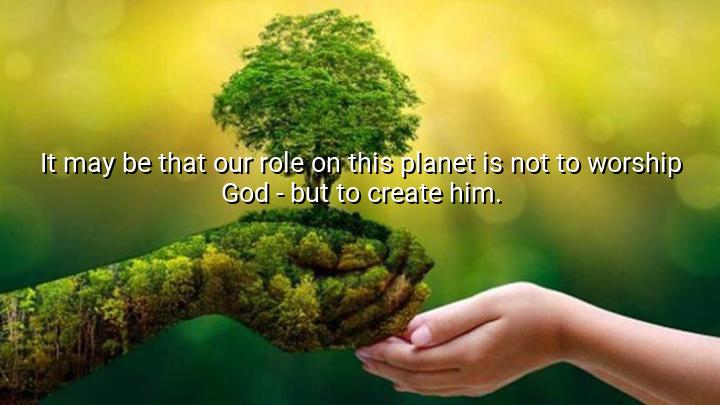




Arthur C. Clarke’s quote, "It may be that our role on this planet is not to worship God – but to create him," presents a thought-provoking idea about the relationship between humanity and the divine. Clarke suggests that instead of viewing God solely as an external, unchanging being to be worshiped, our role may involve a more active, creative process in understanding and bringing forth the divine in the world. This shifts the focus from traditional religious practices to a more existential understanding of spirituality, where humans contribute to the creation or realization of God through their actions, beliefs, and creativity.
The idea of creating God challenges conventional religious thinking by proposing that humanity’s purpose may not just be to acknowledge and follow divine commands but to actively engage with the concept of God in a more dynamic way. It suggests that the divine is not fixed but can be shaped by human thought, imagination, and creativity. This aligns with Clarke’s broader ideas, often explored in his science fiction works, where the boundaries between humanity and the divine or transcendent are blurred, with technology and human evolution playing a key role in that relationship.
Clarke’s quote also speaks to the potential of humanity to shape its spiritual and philosophical future. Instead of seeing ourselves as passive recipients of divine revelation, the idea of creating God implies that we are active participants in the evolution of our understanding of the divine, capable of defining or even transforming the way we perceive God over time. This mirrors the ways in which human civilization evolves through science, art, and culture, where new ideas and perceptions often redefine our understanding of reality.
The origin of this quote likely stems from Clarke's philosophical and scientific outlook on life, which often explored themes of human potential, technology, and the unknown. As a science fiction writer, Clarke was deeply interested in the ways humanity might evolve and interact with the divine, especially as our technological and intellectual capabilities expand. This quote reflects his belief that humanity's greatest role might be to discover and shape its own path, possibly even in the realm of the spiritual, rather than simply following predetermined religious doctrines.

AAdministratorAdministrator
Welcome, honored guests. Please leave a comment, we will respond soon