

It is proof of a base and low mind for one to wish to think with the masses or majority, merely because the majority is the majority. Truth does not change because it is, or is not, believed by a majority of the people.
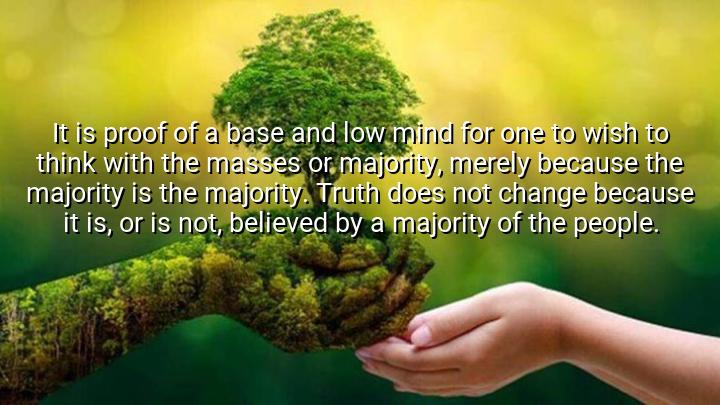




The quote "It is proof of a base and low mind for one to wish to think with the masses or majority, merely because the majority is the majority. Truth does not change because it is, or is not, believed by a majority of the people." is attributed to Giordano Bruno, a 16th-century Italian philosopher, astronomer, and mystic. Bruno was known for his bold and often controversial ideas, especially his advocacy for freethinking, the infinite universe, and the plurality of worlds. This quote reflects his deep belief in intellectual independence and his resistance to conformity driven by social or institutional pressures.
At the core of the quote is Bruno’s assertion that truth is absolute and not subject to the whims of popular opinion. He criticizes the tendency of people to align their beliefs with the majority, not out of reason or evidence, but out of fear, comfort, or a desire to fit in. Bruno calls this mentality “base and low,” highlighting the moral and intellectual weakness in surrendering one’s convictions to societal consensus. For him, genuine thought and discovery require courage, especially when standing against dominant but flawed ideologies.
Bruno’s own life and death give powerful context to this statement. He was tried by the Roman Inquisition and eventually executed for heresy in 1600, largely because his views challenged established religious and scientific doctrines. Despite persecution, he held firm to his beliefs, embodying the very message of the quote: that truth remains truth, regardless of whether it is accepted by the masses or condemned by authorities. His martyrdom later inspired scientists and philosophers who valued freedom of thought.
Ultimately, Giordano Bruno’s quote is a timeless reminder of the importance of intellectual integrity and moral courage. It calls on individuals to seek and defend the truth—not because it is popular, but because it is right. In a world where public opinion often shifts rapidly, Bruno’s words encourage us to value principled conviction over social approval.

AAdministratorAdministrator
Welcome, honored guests. Please leave a comment, we will respond soon