

It is love, not reason, that is stronger than death.
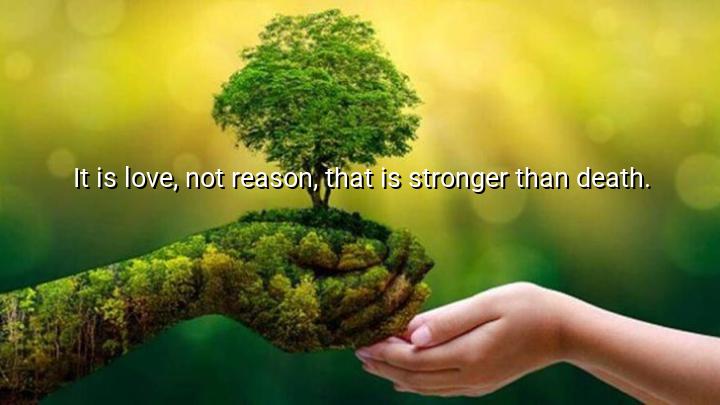




Thomas Mann’s quote, "It is love, not reason, that is stronger than death," suggests that love is a force more enduring and powerful than even the finality of death. While reason and logic can explain life’s events and give structure to existence, it is love that transcends the limitations of human understanding. Love, in this sense, defies the inevitable nature of death, offering a sense of immortality and connection that reason cannot provide. Through love, people find meaning and continuity beyond physical existence, making it a force that persists even in the face of death.
Mann's quote explores the idea that emotion—especially love—is what gives life its deepest significance. While reason may attempt to explain or cope with the concept of death, it is love that gives individuals the ability to endure loss, find solace, and continue to connect with others. Love, whether romantic, familial, or spiritual, is portrayed as a binding force that does not end with the physical body’s death, implying that it has a power that surpasses the boundaries of life and death.
Thomas Mann, known for his literary works like The Magic Mountain and Death in Venice, often grappled with existential themes such as the meaning of life, death, and the human condition. His exploration of love and its connection to mortality is consistent with his broader focus on psychological depth and the complexity of human experiences. In his works, love is often portrayed as a transformative force that enables characters to transcend their individual lives and touch something greater.
The origin of this quote is rooted in Mann’s reflections on life, death, and human emotions, likely inspired by the philosophical and psychological undercurrents in his literary works. By focusing on love’s supremacy over reason and death, Mann highlights the enduring nature of emotional connections, which, in his view, are what truly define the human experience.

AAdministratorAdministrator
Welcome, honored guests. Please leave a comment, we will respond soon