

For the sake of goodness and love, man shall let death have no sovereignty over his thoughts.
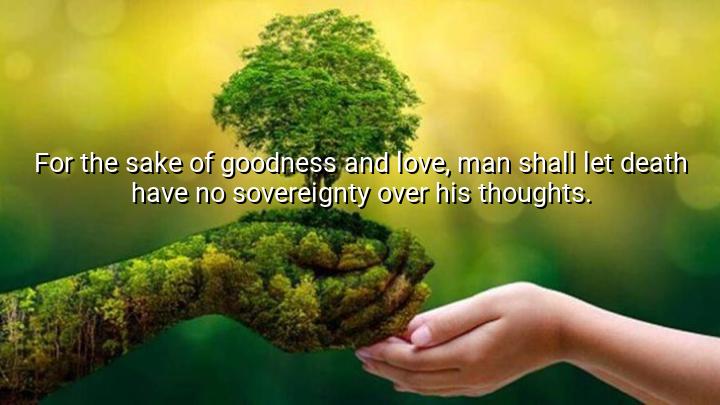




The quote "For the sake of goodness and love, man shall let death have no sovereignty over his thoughts" by Thomas Mann explores the idea that death should not dominate our thoughts or actions. Mann suggests that in order to live a life filled with goodness and love, one must not be consumed by the fear or inevitability of death. Instead, individuals should focus on the positive aspects of life, such as fostering meaningful relationships and embracing kindness, without being overwhelmed by the thought of mortality.
By using the phrase "death has no sovereignty," Mann emphasizes that death should not control our lives. The word "sovereignty" implies dominion or authority, and Mann argues that death should not hold that power over us. Instead, goodness and love should guide our thoughts and actions. This perspective challenges the tendency to focus on death as an inevitable end, urging people to live in the present and to prioritize what truly matters—love, kindness, and the well-being of others.
The origin of this quote lies in the writings of Thomas Mann, a German author renowned for his profound insights into the human condition. His works often dealt with complex themes such as mortality, fate, and the search for meaning in life. This particular quote speaks to Mann’s belief that life should be embraced with all its imperfections and uncertainties, and that love and goodness can help individuals transcend the fear of death and find purpose beyond the physical world.
In a broader context, this quote encourages individuals to shift their focus from death and the fear of the unknown, towards the goodness and love that can be cultivated in everyday life. Mann reminds us that while death is inevitable, it is our actions driven by love and goodness that give life meaning and significance.

AAdministratorAdministrator
Welcome, honored guests. Please leave a comment, we will respond soon