

It is ironic that the one thing that all religions recognize as separating us from our creator, our very self-consciousness, is also the one thing that divides us from our fellow creatures. It was a bitter birthday present from evolution.
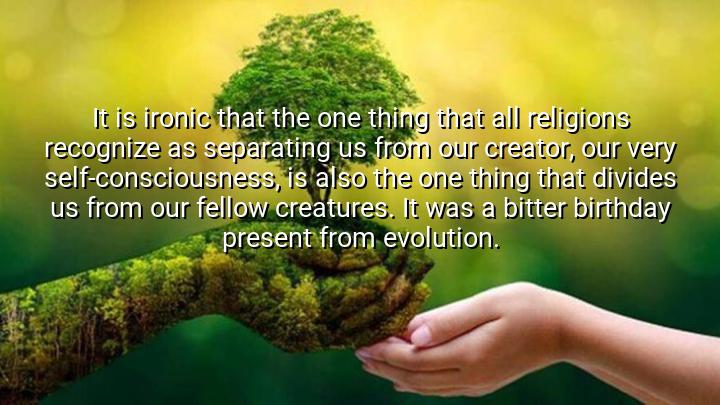




The quote "It is ironic that the one thing that all religions recognize as separating us from our creator, our very self-consciousness, is also the one thing that divides us from our fellow creatures. It was a bitter birthday present from evolution" by Annie Dillard explores the paradox of self-consciousness. While this awareness of our own existence is often viewed as a fundamental aspect of what separates humans from other creatures, it also serves as a barrier that distances us from the rest of the natural world. The quote reflects on the idea that self-consciousness, a gift or curse depending on perspective, is both a source of alienation and separation.
Originating from Annie Dillard's reflections on life and existence, this quote draws from her spiritual and philosophical outlook on human nature. Dillard, known for her deep observations of the natural world, suggests that evolution's gift of self-awareness came with an unintended consequence. While it allows us to reflect on our existence and our connection to a creator, it also distances us from other living beings, making it difficult for us to feel completely at one with nature or our fellow creatures.
The reference to a "bitter birthday present" from evolution underscores the notion that, while self-consciousness has helped humans achieve incredible intellectual and creative feats, it has also introduced a form of existential loneliness. This self-awareness often leads to a sense of separation, as we become more concerned with our own individuality and less connected to the larger world around us. The irony, as Dillard points out, is that the very thing that makes us human also creates a fundamental divide between us and the rest of the natural world.
Ultimately, Dillard's quote highlights the complexity of human existence—where the gift of self-consciousness, while central to human identity, also creates a deep divide. It invites reflection on whether this awareness is truly a blessing or a curse, and whether it keeps us from fully embracing the unity of life around us.

AAdministratorAdministrator
Welcome, honored guests. Please leave a comment, we will respond soon