

In the future, I'm sure there will be a lot more robots in every aspect of life. If you told people in 1985 that in 25 years they would have computers in their kitchen, it would have made no sense to them.
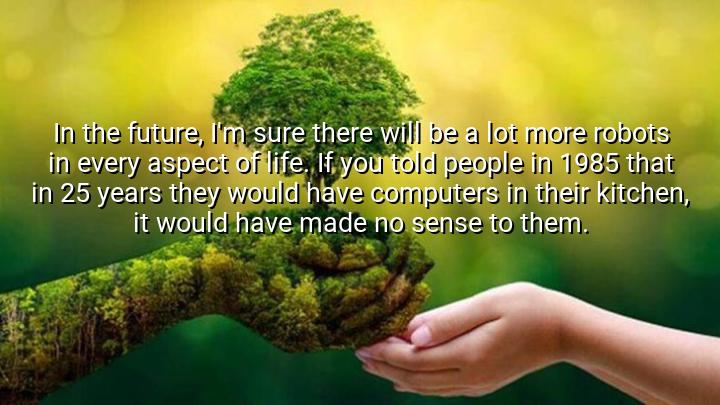




The quote, "In the future, I'm sure there will be a lot more robots in every aspect of life. If you told people in 1985 that in 25 years they would have computers in their kitchen, it would have made no sense to them," by Rodney Brooks, reflects on the rapid pace of technological advancement and how developments that seem unimaginable today might become commonplace in the near future. Brooks, a roboticist and computer scientist, is pointing out that just as computers have become integral to daily life—particularly in household appliances—robots will similarly become ubiquitous, playing a larger role in all aspects of life.
The origin of this quote is rooted in Brooks' expertise in robotics and his work in the artificial intelligence field. By referencing 1985, a time when the idea of a computer in every home kitchen would have been far-fetched, he highlights the way technology progresses in unexpected and often exponential ways. This comment also ties into his own career, where he helped shape the future of robots and autonomous machines. Brooks is suggesting that, just as the personal computer revolutionized how we interact with technology, robots will soon revolutionize our daily activities and routines.
At its core, the quote is about the unpredictable trajectory of technological innovation. Brooks emphasizes that society has historically underestimated the speed at which new technologies are adopted and integrated into everyday life. What once seemed futuristic or unrealistic quickly becomes accepted and commonplace. His observation serves as a reminder that progress can sometimes appear sudden, and the possibilities of robots and other advanced technologies could soon be as integrated into daily life as the computers we use today.
The quote also invites reflection on the changing role of technology in our homes and society. In 1985, the idea of having computers in kitchens, let alone robots, would have been difficult to envision. Yet, today, smart kitchen appliances and digital assistants are part of daily routines, and robots are increasingly taking on more functions in manufacturing, healthcare, and even personal assistance. Brooks is suggesting that this evolution is just the beginning, and in the near future, robots will play a much more significant and visible role in shaping our world.

AAdministratorAdministrator
Welcome, honored guests. Please leave a comment, we will respond soon