

In religion, symbols have always played a iconographic and ritualistic role. Different symbols might represent different theological ideas.
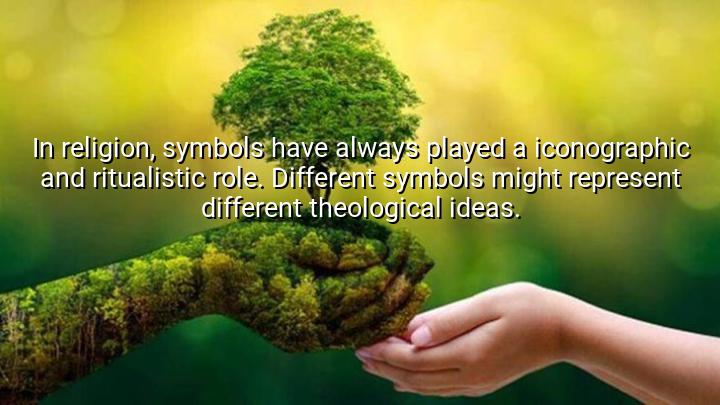




The quote by Trevor Paglen emphasizes the important role of symbols in religion, highlighting their iconographic and ritualistic functions. Symbols serve as visual or tangible representations of complex theological ideas, allowing believers to understand, communicate, and experience abstract spiritual concepts more concretely. By using symbols, religions create a shared language that conveys meaning beyond words.
Paglen notes that different symbols can represent distinct theological ideas, reflecting the diversity and richness of religious traditions. For example, a cross in Christianity, the crescent in Islam, or the lotus in Buddhism each carries unique spiritual significance and conveys specific teachings, values, or stories. These symbols help structure rituals, inspire reflection, and foster a sense of community among practitioners.
The origin of the quote comes from Trevor Paglen, an artist and researcher known for exploring themes of visual culture, surveillance, and societal structures. His reflections on religious symbolism connect his broader interest in how visual forms shape human perception, knowledge, and understanding. Paglen’s work often examines the intersection of symbol, meaning, and interpretation in both spiritual and cultural contexts.
Ultimately, the quote conveys a message about the power of symbols in shaping religious thought and practice. Paglen reminds us that symbols are not merely decorative—they are vehicles of meaning, providing believers with a way to internalize complex theological concepts, participate in shared rituals, and engage with the deeper dimensions of faith.
I can also create a concise, bolded version for quick reference if you want.

AAdministratorAdministrator
Welcome, honored guests. Please leave a comment, we will respond soon