

Art is more than a series of images that are disembodied. Art is objects that live in real places, economies, spaces, architecture.
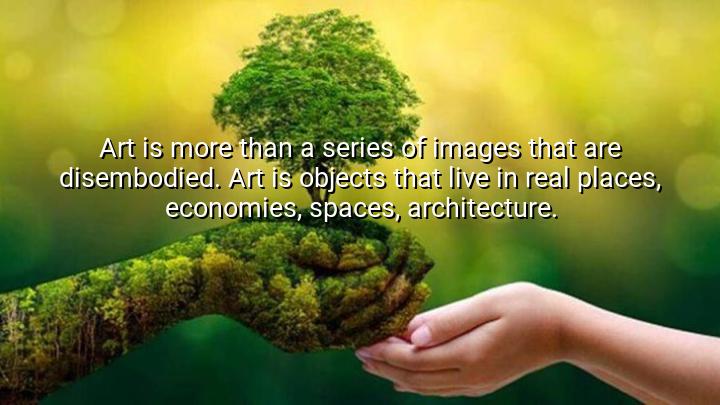




Trevor Paglen’s quote challenges the notion of art as something abstract or detached from the real world. When he says, “Art is more than a series of images that are disembodied,” he critiques the idea of art as merely aesthetic visuals or isolated experiences. Instead, he insists that art is made up of objects that have a physical presence, shaped by and interacting with real environments, social systems, and built spaces. This perspective grounds art in materiality and context, rather than treating it as something that exists in a vacuum.
By stating that art “lives in real places, economies, spaces, architecture,” Paglen emphasizes the interconnectedness between creative works and the systems they inhabit. Art is influenced by economics, from who funds and collects it to where it's exhibited or sold. It occupies physical spaces, whether in galleries, public areas, or homes, and engages with architecture, both as a backdrop and as part of its meaning. In this way, art is not just viewed—it is experienced within a network of social, political, and physical structures.
Paglen’s perspective stems from his broader practice as an artist, geographer, and activist, known for exploring themes like surveillance, power, and technology. His work often investigates invisible infrastructures—from classified military sites to undersea data cables—highlighting how art can expose hidden realities. His quote reflects a belief that art must engage with the world, and that its significance often comes from how it interacts with real-world systems rather than from being removed from them.
This quote originates from interviews and essays where Trevor Paglen discusses his approach to contemporary art. Rejecting the idea of art as purely visual or symbolic, he advocates for a practice that is situated, tangible, and critically engaged. His view invites audiences to reconsider art not just as image or expression, but as a force embedded in the structures and spaces that shape our lives.

AAdministratorAdministrator
Welcome, honored guests. Please leave a comment, we will respond soon