

In dreams the truth is learned that all good works are done in the absence of a caress.
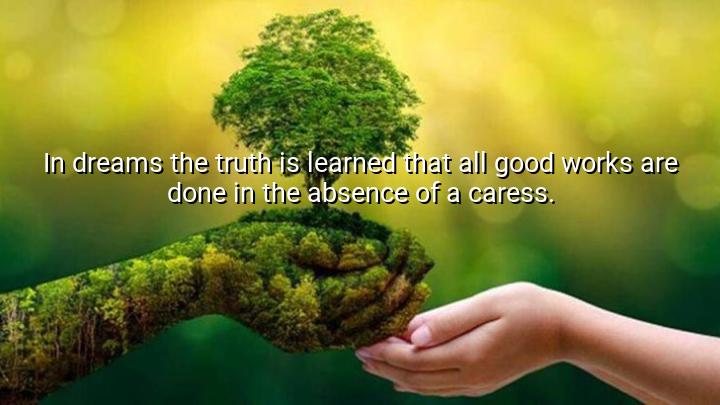




The quote "In dreams the truth is learned that all good works are done in the absence of a caress" by Leonard Cohen reflects a deep philosophical perspective on the nature of creativity, sacrifice, and the role of affection in human endeavors. Cohen suggests that in the realm of dreams, or perhaps in our subconscious mind, we come to realize that the greatest achievements or works are often accomplished without the comforting or nurturing influence of a caress—a symbol of love, care, or support. This could imply that true growth and productivity are often the result of solitude, hardship, or personal struggle, rather than external validation or affection.
The absence of a caress can be interpreted as the necessity of self-reliance in the pursuit of important goals. The quote speaks to the idea that while love and support are vital to emotional well-being, the act of creating, achieving, or finding truth often requires independence and isolation. Good works, in this sense, might refer to achievements that are born out of perseverance and inner strength, rather than external encouragement.
Cohen’s words may also suggest that dreams—whether literal or metaphorical—allow us to confront the more difficult and sometimes uncomfortable truths about ourselves and the world. In our dreams, we face the reality that personal fulfillment and greatness are often found through personal sacrifice, and that affection or care, while beautiful, may not always be a driving force behind success or meaningful action.
The origin of this quote lies within Cohen's poetic and reflective body of work. Known for his songs, poetry, and philosophical musings, Cohen often explored themes of love, loss, and the human condition. This quote reflects his ability to convey deep insights into the human experience, blending artistic expression with spiritual and existential reflections. His perspective on the role of dreams and the absence of caress aligns with his broader themes of solitude and introspection.

AAdministratorAdministrator
Welcome, honored guests. Please leave a comment, we will respond soon