

In a liquid modern life there are no permanent bonds, and any that we take up for a time must be tied loosely so that they can be untied again, as quickly and as effortlessly as possible, when circumstances change - as they surely will in our liquid modern society, over and over again.
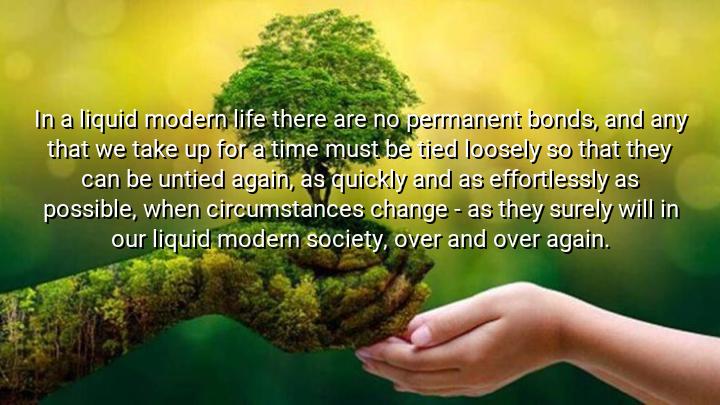




The quote by Zygmunt Bauman, "In a liquid modern life there are no permanent bonds, and any that we take up for a time must be tied loosely so that they can be untied again, as quickly and as effortlessly as possible, when circumstances change—as they surely will in our liquid modern society, over and over again," reflects his critical view of the fluidity and instability of contemporary life. Bauman uses the term "liquid modernity" to describe a world where social structures, relationships, and identities are constantly shifting, making it difficult to form long-term commitments or lasting connections.
The idea of "loosely tied bonds" captures the essence of relationships and affiliations in modern society—ones that are often temporary, flexible, and easily dissolved. In such a world, people are encouraged to keep options open, adapt quickly, and avoid permanence, because the future is perceived as uncertain and ever-changing. Bauman argues that while this can offer freedom, it also leads to feelings of insecurity, fragmentation, and emotional detachment.
Zygmunt Bauman was a prominent Polish sociologist and philosopher, best known for his exploration of postmodernism, consumer culture, and globalization. His concept of liquid modernity, introduced in the early 2000s, describes the shift from a "solid" society—built on long-term structures like family, career, and institutions—to one marked by constant flux, where everything from jobs to values becomes temporary and negotiable. This quote embodies his concern about how these changes affect human relationships and identity.
Ultimately, Bauman’s message is both descriptive and cautionary. He challenges us to consider the cost of living in a society where everything is designed for mobility and impermanence. While such flexibility might seem practical, it may also erode the depth, trust, and stability that come from enduring connections. His work encourages a deeper reflection on how we form and maintain meaningful bonds in an age of constant change.

AAdministratorAdministrator
Welcome, honored guests. Please leave a comment, we will respond soon