

In a few decades, the relationship between the environment, resources and conflict may seem almost as obvious as the connection we see today between human rights, democracy and peace.
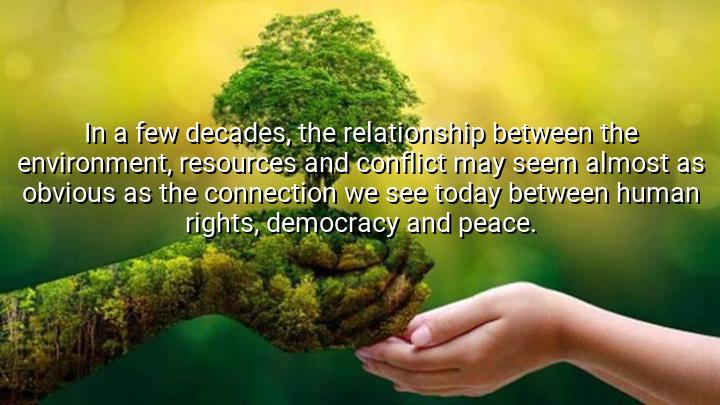




The quote “In a few decades, the relationship between the environment, resources and conflict may seem almost as obvious as the connection we see today between human rights, democracy and peace” by Wangari Maathai emphasizes the critical link between environmental sustainability and global stability. Maathai highlights that resource management and ecological health are not just ecological concerns, but are deeply intertwined with social and political outcomes, including the potential for conflict. She suggests that future generations may recognize the environment as foundational to peace and security, just as human rights and democracy are widely acknowledged today.
Wangari Maathai, a Kenyan environmentalist, political activist, and Nobel Peace Prize laureate, was a pioneer in linking environmental protection with social justice. Through initiatives like the Green Belt Movement, she emphasized the importance of reforestation, sustainable resource use, and community empowerment. This quote reflects her understanding that environmental degradation can exacerbate social tensions, and that proactive stewardship is essential for long-term peace and stability.
The quote also illustrates a broader principle about systems thinking and interconnectedness. Maathai stresses that environmental, social, and political factors are deeply connected, and ignoring one can have cascading effects on the others. By highlighting the eventual obviousness of these links, she underscores the urgency of integrating environmental awareness into policy, governance, and education to prevent conflict and foster sustainable development.
Ultimately, Maathai’s statement serves as a reminder that environmental stewardship is inseparable from human well-being and global peace. It encourages societies to recognize the interdependence of ecological health, resource management, and social stability, showing that the choices we make today regarding the environment will shape the security, prosperity, and harmony of future generations. Her words celebrate the vision of a world where sustainability and peace are mutually reinforcing.

AAdministratorAdministrator
Welcome, honored guests. Please leave a comment, we will respond soon