

In Kenya women are the first victims of environmental degradation, because they are the ones who walk for hours looking for water, who fetch firewood, who provide food for their families.
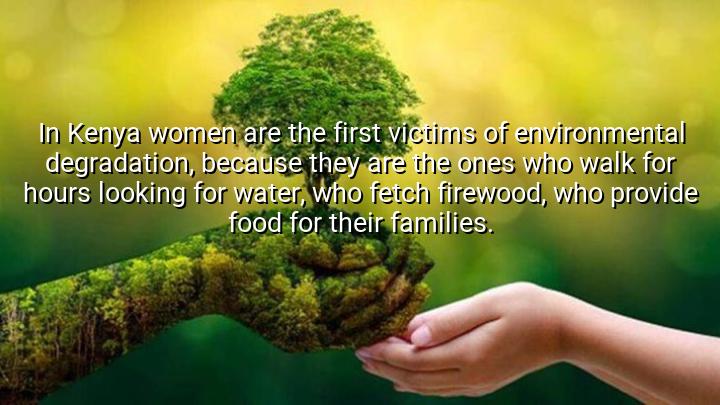




The quote “In Kenya women are the first victims of environmental degradation, because they are the ones who walk for hours looking for water, who fetch firewood, who provide food for their families.” by Wangari Maathai highlights the deeply interconnected relationship between gender, environment, and poverty. Maathai, a Kenyan environmental activist, Nobel Peace Prize laureate, and founder of the Green Belt Movement, dedicated her life to advocating for both ecological restoration and women’s rights. This quote encapsulates her understanding that environmental harm disproportionately affects women, especially in rural areas where they are the primary caregivers and resource gatherers.
By focusing on women’s daily responsibilities—walking long distances for water, collecting firewood, and securing food—Maathai draws attention to the invisible burdens placed on women when ecosystems are degraded. Deforestation, drought, and pollution mean that these essential tasks become more difficult, time-consuming, and dangerous. In this way, environmental crises are not just ecological issues but also deeply social and gendered problems that reinforce cycles of inequality and hardship.
The origin of this quote lies in Maathai’s grassroots work across Kenya, where she witnessed firsthand how deforestation and land degradation made life harder for women. Her Green Belt Movement planted millions of trees not just to restore the environment but to empower women, provide them with income, and reduce their labor burden. Her environmental philosophy was rooted in community-based action, where protecting nature and improving women's lives were seen as mutually reinforcing goals.
Ultimately, this quote is a call for environmental justice that includes gender equity at its core. Wangari Maathai reminds us that true sustainability must account for the human dimension of ecological damage, especially how it impacts the most vulnerable. Her legacy continues to inspire movements around the world that fight for both planetary health and social empowerment, proving that the two are deeply intertwined.

AAdministratorAdministrator
Welcome, honored guests. Please leave a comment, we will respond soon