

If you use your mind to study reality, you won't understand either your mind or reality. If you study reality without using your mind, you'll understand both.
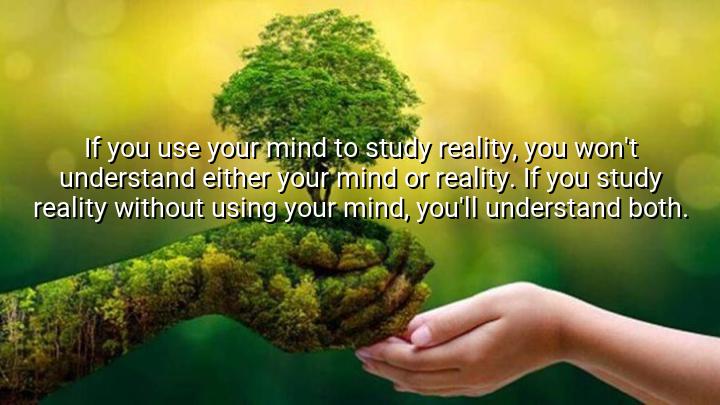




The quote, "If you use your mind to study reality, you won't understand either your mind or reality. If you study reality without using your mind, you'll understand both," by Bodhidharma, explores the concept of direct experience and non-conceptual understanding. Bodhidharma suggests that relying solely on analytical thinking or intellectual reasoning can limit true comprehension. To understand reality and the mind, one must transcend conventional thought and experience things directly, without the interference of preconceptions.
Bodhidharma (circa 5th–6th century CE) was a Buddhist monk traditionally credited as the founder of Zen Buddhism in China. He emphasized meditation, introspection, and experiential insight over purely intellectual study. This quote reflects his core teaching that genuine understanding arises from direct awareness and mindfulness rather than abstract reasoning or scholarly analysis.
The statement highlights the distinction between conceptual knowledge and experiential insight. Using the mind in a conventional way to study reality may lead to intellectualization, creating a separation between observer and observed. By studying reality without overreliance on analytical thought—through meditation or mindful observation—one can perceive the interconnectedness of mind and world and gain authentic understanding.
Ultimately, the quote encourages cultivating direct experience, mindfulness, and inner awareness. Bodhidharma teaches that true wisdom comes from transcending conventional thinking and engaging with reality as it is. It is a reminder that learning and understanding are not solely intellectual endeavors but involve attentive observation, presence, and insight.

AAdministratorAdministrator
Welcome, honored guests. Please leave a comment, we will respond soon