

If you look at great human civilizations, from the Roman Empire to the Soviet Union, you will see that most do not fail simply due to external threats but because of internal weakness, corruption, or a failure to manifest the values and ideals they espouse.
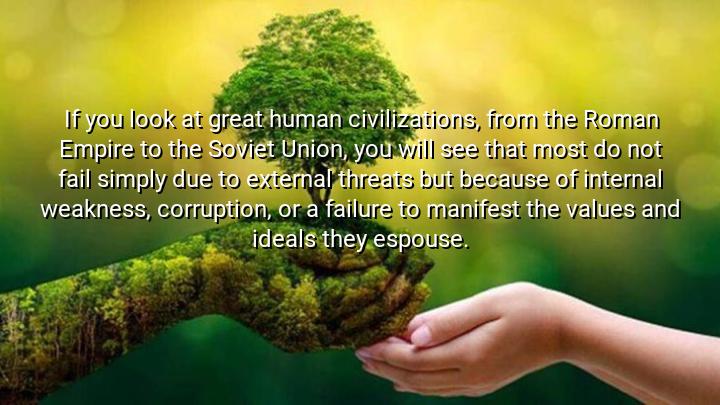




In this quote, Cory Booker reflects on the collapse of great human civilizations, drawing examples from the Roman Empire and the Soviet Union. He suggests that these societies did not fail solely because of external threats such as invasions or wars, but rather due to internal weaknesses like corruption and the inability to live up to their own values and ideals. Booker emphasizes the importance of internal integrity and the failure of societies to uphold the principles they claim to represent as crucial factors in their downfall.
The quote serves as a reminder that external threats are often not the most significant cause of a civilization's decline. Instead, internal issues like political corruption, societal inequality, and a failure to act in accordance with founding ideals can erode the foundations of even the most powerful empires. In essence, Booker suggests that the moral and ethical integrity of a society are key to its survival and strength.
Booker’s message also speaks to the relevance of these lessons in contemporary society. He is cautioning against complacency, urging that nations and societies must continuously evaluate their values and ensure that their actions align with those ideals. If the internal fabric of a society weakens—through inequality, corruption, or a failure to live by the values it espouses—its decline becomes inevitable, regardless of external challenges.
Ultimately, the quote underscores the idea that the true strength of a civilization lies in its ability to maintain moral integrity and internal cohesion. It calls for an ongoing commitment to the values that define a society, suggesting that a failure to uphold these principles will ultimately lead to its decline, regardless of external forces.

AAdministratorAdministrator
Welcome, honored guests. Please leave a comment, we will respond soon