

If you call yourself a leader, then you have to be decisive. If you're decisive, then you have the chance to be a leader. These are two sides to the same coin.
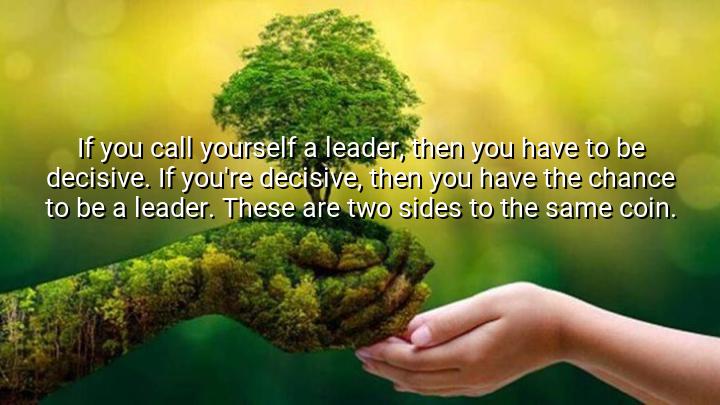




The quote "If you call yourself a leader, then you have to be decisive. If you're decisive, then you have the chance to be a leader. These are two sides to the same coin." comes from Narendra Modi, the Prime Minister of India since 2014. In this statement, Modi draws a direct connection between leadership and decisiveness, presenting them as inseparable qualities. His metaphor of "two sides to the same coin" emphasizes that one cannot truly exist without the other.
The meaning behind the quote is that effective leadership is rooted in the ability to make clear, timely, and confident decisions. A leader who hesitates or avoids difficult choices risks losing credibility and influence, while someone who consistently demonstrates decisiveness naturally earns opportunities to lead. Modi frames this relationship as cyclical—leadership demands decisiveness, and decisiveness opens the door to leadership.
The origin of this perspective is tied to Modi’s own political career, which has been marked by bold policy moves and firm stances on both domestic and international issues. From major economic reforms to strategic infrastructure projects, he has cultivated an image of a leader who does not shy away from taking strong, sometimes controversial, actions. This belief in decisive governance aligns with his broader political message of strength, clarity, and national purpose.
Ultimately, Modi’s words serve as both advice and a standard for leadership. By portraying decision-making and leadership as two halves of the same whole, he underscores that authority is not merely a title—it is earned and maintained through the willingness to act with confidence and responsibility, even in the face of uncertainty.

AAdministratorAdministrator
Welcome, honored guests. Please leave a comment, we will respond soon