

If you are neutral in situations of injustice, you have chosen the side of the oppressor. If an elephant has its foot on the tail of a mouse and you say that you are neutral, the mouse will not appreciate your neutrality.
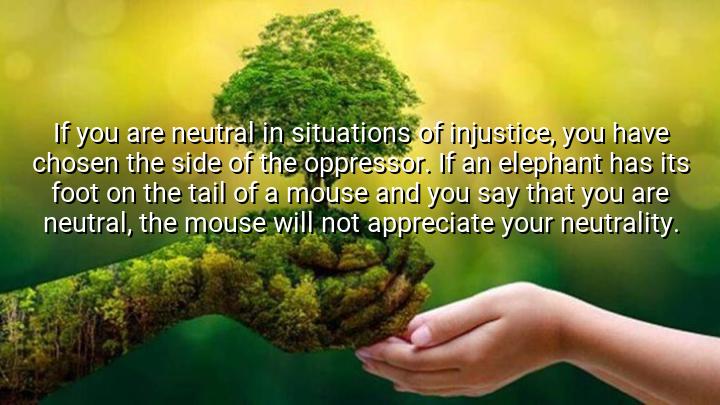




The quote "If you are neutral in situations of injustice, you have chosen the side of the oppressor. If an elephant has its foot on the tail of a mouse and you say that you are neutral, the mouse will not appreciate your neutrality" by Desmond Tutu, a South African Anglican bishop and social rights activist, emphasizes the moral responsibility to take a stand against injustice. Tutu argues that neutrality in the face of wrongdoing is not a neutral position but an implicit support for the oppressor. When one fails to act against oppression, they effectively enable it, as silence or inaction serves the interests of those perpetrating the injustice.
Tutu uses the metaphor of an elephant and a mouse to illustrate the stark contrast in power dynamics. The elephant, representing the powerful or oppressive force, is unbothered by the mouse's discomfort, yet the mouse—symbolizing the oppressed—would understandably object to the elephant's actions. The neutral party, in this case, is like someone who witnesses the injustice and chooses not to intervene, making them complicit in the situation. The mouse would not view their neutrality as a benign or fair position but as one that sides with the more powerful, even by failing to act.
This quote speaks to the importance of standing up for what is right and actively opposing oppression, especially when it is easy to remain passive. Tutu’s words challenge the idea that one can remain unbiased or indifferent when faced with moral or social injustice. Instead, he insists that inaction in these situations is equivalent to supporting the status quo of inequality and suffering.
Ultimately, Tutu’s statement is a call to action and moral engagement. It reminds us that we are responsible for making ethical choices and that our silence in the face of injustice can perpetuate harm. It highlights the importance of courage and advocacy in fighting for justice, not just for ourselves but for those who cannot fight for themselves.

AAdministratorAdministrator
Welcome, honored guests. Please leave a comment, we will respond soon