

If we want things to stay as they are, things will have to change.
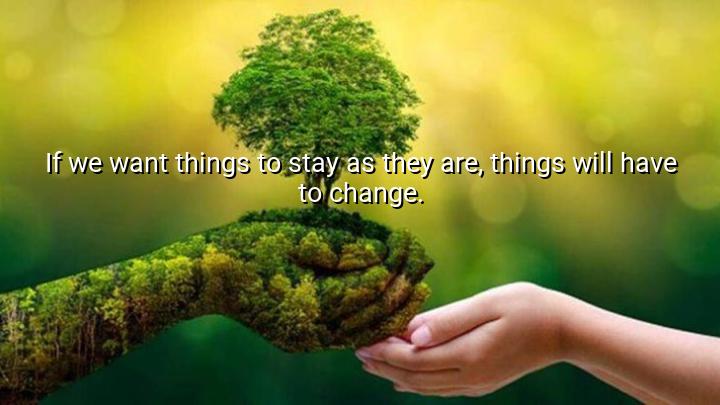




The quote by Giuseppe Tomasi di Lampedusa, "If we want things to stay as they are, things will have to change," captures a paradoxical but deeply insightful truth about adaptation and preservation. At first glance, it seems contradictory—how can change preserve the status quo? But Lampedusa is pointing out that in order to maintain stability in a dynamic world, some level of transformation is not only inevitable but essential. To resist all change is to risk becoming obsolete or losing control altogether.
This quote comes from Lampedusa’s novel The Leopard (Il Gattopardo), a landmark of Italian literature that explores the decline of the Sicilian aristocracy during Italy’s 19th-century unification. The line is spoken by a character representing the old ruling class, who realizes that to retain power and influence, the elite must accept and even direct some of the revolutionary shifts happening around them. It’s a statement about the politics of survival—how entrenched systems must evolve to continue existing in new contexts.
At its core, the quote reflects a deep understanding of political strategy and human nature. It implies that surface-level reforms or symbolic changes can be used to appease demand for progress while preserving core interests. It also applies beyond politics—to organizations, traditions, and even personal life—suggesting that flexibility is often the key to endurance.
Ultimately, Lampedusa’s message is about the complex relationship between continuity and change. It warns against rigidity and invites a more nuanced approach: that to safeguard what we value, we must be willing to let go of what no longer works. Change, paradoxically, becomes the tool by which we protect constancy.

AAdministratorAdministrator
Welcome, honored guests. Please leave a comment, we will respond soon