

If children understand that beliefs should be substantiated with evidence, as opposed to tradition, authority, revelation or faith, they will automatically work out for themselves that they are atheists.
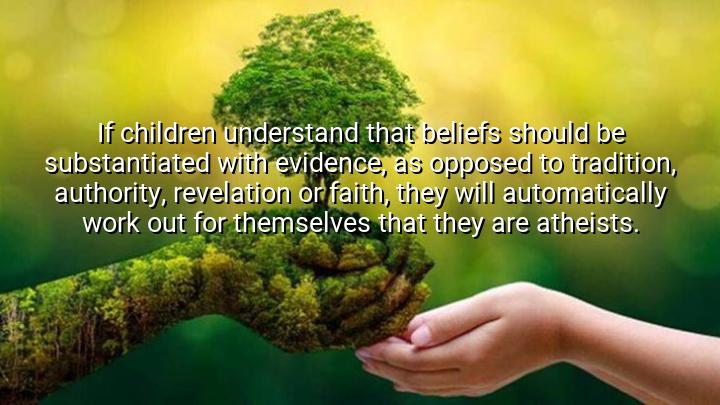




The quote by Richard Dawkins, "If children understand that beliefs should be substantiated with evidence, as opposed to tradition, authority, revelation or faith, they will automatically work out for themselves that they are atheists," emphasizes the importance of evidence-based thinking. Dawkins argues that when children are taught to critically evaluate claims and seek evidence for their beliefs, they are less likely to accept ideas purely based on tradition, authority, or faith. He suggests that this approach to reasoning will naturally lead them toward atheism, as many religious beliefs are grounded in non-empirical sources.
Richard Dawkins, a prominent evolutionary biologist and outspoken advocate for secularism and science, has long promoted rational inquiry over blind belief. This quote reflects his central philosophy that critical thinking is essential for understanding reality. Dawkins often contrasts evidence with what he sees as unreliable sources of belief, such as revelation or inherited traditions, which are common in many religions.
The origin of the quote stems from Dawkins’ broader body of work, particularly his best-selling book The God Delusion (2006), where he critiques religion and advocates for a scientific worldview. He argues that when children are taught how to think rather than what to think, they become empowered to question unfounded claims, including those related to the existence of God or the supernatural.
Ultimately, the quote serves as both a critique of indoctrination and a call for rational education. Dawkins’ words underscore his belief that fostering skepticism and a reliance on evidence will encourage intellectual independence. By learning to analyze the foundations of belief, children can make their own conclusions about the world, free from the influence of dogma.

AAdministratorAdministrator
Welcome, honored guests. Please leave a comment, we will respond soon