

I would rather live my life as if there is a God and die to find out there isn't, than live as if there isn't and to die to find out that there is.
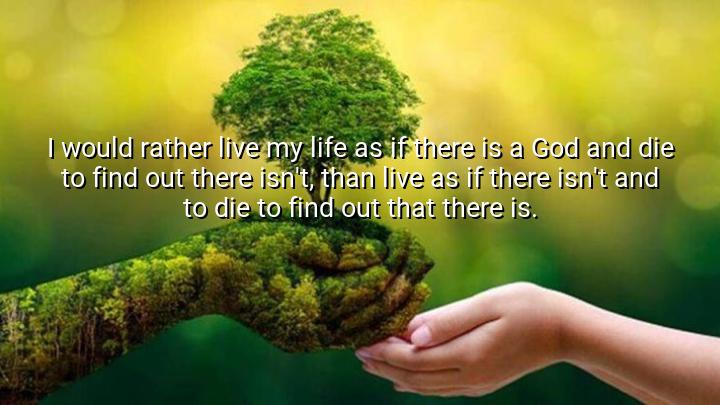




The quote "I would rather live my life as if there is a God and die to find out there isn't, than live as if there isn't and to die to find out that there is" by Blaise Pascal reflects his famous argument known as Pascal’s Wager, which is a philosophical reasoning about the existence of God. Pascal argues that it is safer and more rational to live as if God exists, because if God does exist, the rewards are eternal, whereas if God does not exist, the consequences are minimal. In contrast, living as though God does not exist, if God does in fact exist, could result in eternal consequences. This wager emphasizes the practical benefits of believing in God while hedging against the possibility of His existence.
The origin of this quote is found in Pascal's work Pensées, a collection of thoughts on theology, philosophy, and human nature. Pascal, a French mathematician, philosopher, and theologian, sought to defend the Christian faith by arguing that belief in God is a rational choice, especially when considering the potential risks and rewards. The quote embodies his view that belief in God is a reasonable "bet" because the stakes of believing are infinitely better than the consequences of disbelief.
In this context, Pascal presents the idea that faith in God is not just a matter of metaphysical certainty but a practical decision about how to live. The wager emphasizes the importance of choosing faith even in the face of uncertainty. Pascal suggests that, in the end, the benefits of believing far outweigh the risks of disbelief, particularly when considering the potential for eternal salvation versus eternal loss.
Ultimately, Pascal’s quote calls individuals to reflect on the consequences of their beliefs and actions, especially regarding faith and the existence of God. By framing belief as a rational choice with significant personal implications, Pascal encourages a thoughtful approach to spirituality, one that prioritizes God’s possible existence as a central factor in life decisions.

AAdministratorAdministrator
Welcome, honored guests. Please leave a comment, we will respond soon