

I regard the brain as a computer which will stop working when its components fail. There is no heaven or afterlife for broken down computers; that is a fairy story for people afraid of the dark.
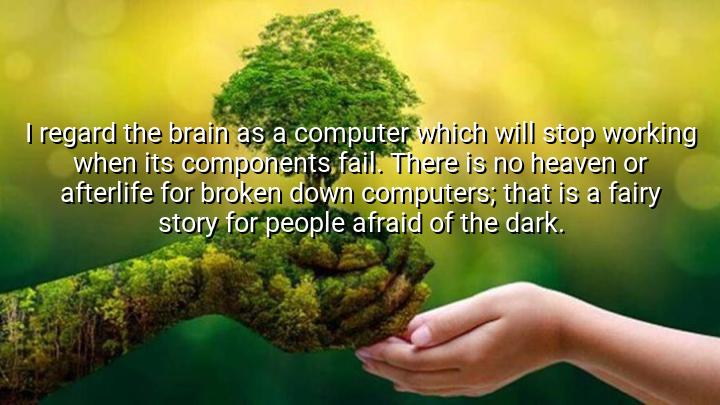




The quote, "I regard the brain as a computer which will stop working when its components fail. There is no heaven or afterlife for broken down computers; that is a fairy story for people afraid of the dark," comes from Stephen Hawking, the renowned theoretical physicist and cosmologist. In this statement, Hawking draws a parallel between the brain and a computer, suggesting that when the brain's components (such as neurons and synapses) cease functioning, the mind will cease to operate, much like a computer stops working when its parts fail. He dismisses the idea of an afterlife or heaven as a comforting myth created by those who fear death or the unknown.
The origin of this quote lies in Hawking’s atheism and his scientific worldview, which rejected religious notions of an afterlife in favor of an understanding based on biology and physics. As a scientist, Hawking was known for his logical and evidence-based approach to the nature of the universe, and this quote reflects his belief that death is a natural end, with no continuation of consciousness beyond the physical function of the body. He characterizes the belief in an afterlife as a fairy story, reinforcing his view that such beliefs are merely a coping mechanism for those afraid of death.
In a broader context, this quote touches on the philosophical debate between science and religion, particularly regarding the nature of consciousness and life after death. Hawking’s statement challenges the spiritual and religious explanations for the afterlife, asserting that when the brain ceases to function, so does consciousness. It presents a stark view of mortality, emphasizing the finality of death from a scientific perspective.
Ultimately, Hawking’s quote is a direct commentary on his materialistic view of the universe, where everything, including the mind and consciousness, can be explained through scientific principles. It serves as a reminder of his conviction that reason and empirical evidence are the keys to understanding existence, and that the idea of an afterlife is a myth created out of fear rather than reality.

AAdministratorAdministrator
Welcome, honored guests. Please leave a comment, we will respond soon