

I realized if you can change a classroom, you can change a community, and if you change enough communities you can change the world.
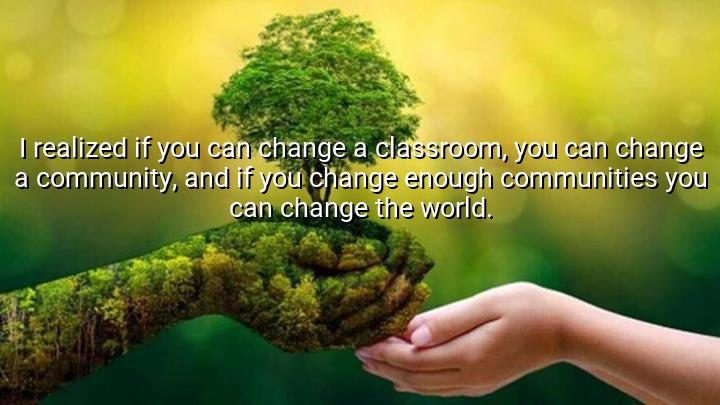




Erin Gruwell’s quote, “I realized if you can change a classroom, you can change a community, and if you change enough communities you can change the world,” emphasizes the transformative power of education. At its core, the quote highlights how meaningful change begins on a small, local scale, often starting with a classroom—a place where minds are shaped, voices are heard, and lives are empowered. Gruwell suggests that through teaching, one can create a ripple effect that expands far beyond the school walls.
The idea that a classroom can influence a community underscores the role of educators not just as transmitters of knowledge, but as mentors, advocates, and change-makers. When students are inspired and equipped to think critically, believe in themselves, and act with empathy, they carry those values into their families and neighborhoods. As more classrooms become centers of empowerment, entire communities begin to evolve, shifting attitudes and fostering collective progress.
Gruwell’s broader message speaks to the power of collective impact. By multiplying the influence of individual classrooms across different areas, a cumulative change can occur—leading to global transformation. Her vision is optimistic but rooted in real experience, demonstrating how education can be a foundational force for social justice, equality, and hope.
The origin of this quote is deeply tied to Erin Gruwell’s real-life work as a teacher in Long Beach, California, where she taught at-risk students and inspired them to tell their stories through writing. Her journey was made famous through the book and film Freedom Writers, which chronicled her efforts to transform her classroom into a space of opportunity and healing. This quote captures her belief that every act of upliftment in education holds the potential to change the world, one student at a time.

AAdministratorAdministrator
Welcome, honored guests. Please leave a comment, we will respond soon