

I know the joy of fishes in the river through my own joy, as I go walking along the same river.
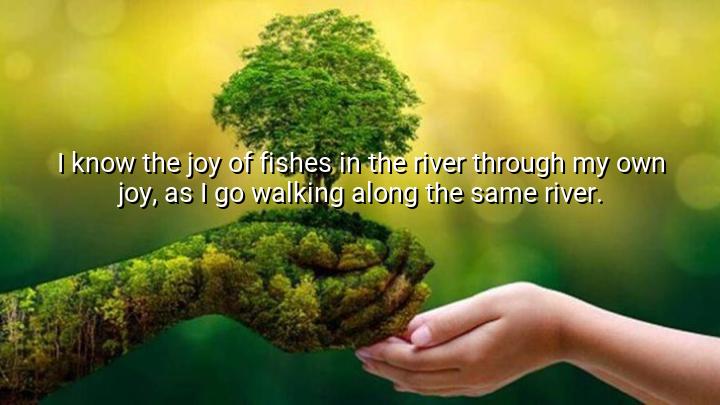




In this quote, Zhuangzi, an ancient Chinese philosopher, reflects on the profound connection between self-awareness and the natural world. He suggests that by experiencing joy in one's own life, a person can understand and relate to the joy of other beings, symbolized by the fishes in the river. This idea emphasizes the interconnectedness of all living things, where personal experiences of joy can mirror the experiences of others, even those vastly different from oneself.
Zhuangzi’s message also highlights the concept of harmony with nature. By walking along the river, he places himself in the same environment as the fishes, suggesting that true understanding comes from being present and in tune with the world around you. The joy of the fishes is not something distant or alien but something that can be understood and shared through direct experience and empathy, fostering a deeper connection with all life.
The origin of this quote is rooted in Daoist philosophy, which emphasizes spontaneity, the natural flow of life, and the unity of all things. Zhuangzi, one of the key figures in Daoism, often explored the idea of living in accordance with the natural world and recognizing the inherent wisdom in simply being present. His teachings encourage individuals to let go of rigid thinking and embrace the fluidity of life, understanding that joy and wisdom can be found in the simplest of experiences.
Ultimately, Zhuangzi’s quote encourages us to seek joy not only in our own lives but also to recognize that the experiences of others—whether human or non-human—are accessible and meaningful. By embracing a deep connection with nature and all beings, we can achieve a more profound understanding of life, finding joy in both our own existence and in the world around us.

AAdministratorAdministrator
Welcome, honored guests. Please leave a comment, we will respond soon