

I hope for nothing. I fear nothing. I am free.
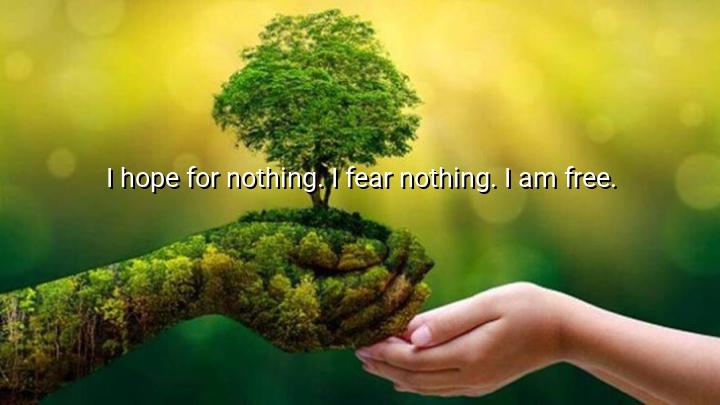




The quote "I hope for nothing. I fear nothing. I am free." is attributed to Nikos Kazantzakis, a celebrated Greek author, philosopher, and thinker best known for works such as Zorba the Greek and The Last Temptation of Christ. This powerful declaration is inscribed on his tombstone, symbolizing the essence of his existential philosophy. Kazantzakis was deeply influenced by Nietzsche, Buddhism, and Christian mysticism, and his writings often explore the tension between spiritual yearning and earthly struggle.
At its core, the quote expresses a radical form of inner freedom—one that arises when a person lets go of both attachment and fear. By saying he hopes for nothing, Kazantzakis suggests detachment from expectations and desires for the future. Likewise, in fearing nothing, he demonstrates liberation from anxiety, especially fear of death, failure, or the unknown. Free from these emotional binds, he asserts a state of true freedom—a condition where one lives fully in the present, unchained by either longing or dread.
This outlook aligns with existential and stoic thought, where freedom is found not in external circumstances but in one’s attitude toward life. For Kazantzakis, freedom is not indulgence or lack of responsibility, but a deep personal discipline and acceptance of life as it is—without illusions. It’s the freedom of one who has made peace with both suffering and transcendence.
Ultimately, Kazantzakis’s quote is a profound reflection on detachment, self-mastery, and spiritual liberation. It challenges us to examine how much of our suffering comes from our hopes and fears, and invites us to explore what it means to live with clarity, courage, and freedom of the soul.

AAdministratorAdministrator
Welcome, honored guests. Please leave a comment, we will respond soon