

A weak soul does not have the endurance to resist the flesh for very long. It grows heavy, becomes flesh itself, and the contest ends. But among responsible men, men who keep their eyes riveted day and night upon the Supreme Duty, the conflict between flesh and spirit breaks out mercilessly and may last until death.
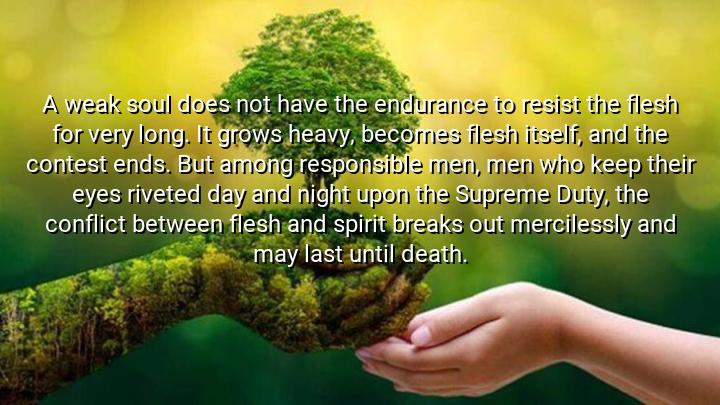




The quote "A weak soul does not have the endurance to resist the flesh for very long. It grows heavy, becomes flesh itself, and the contest ends. But among responsible men, men who keep their eyes riveted day and night upon the Supreme Duty, the conflict between flesh and spirit breaks out mercilessly and may last until death" by Nikos Kazantzakis speaks to the internal struggle between flesh (the physical desires) and spirit (the higher moral or spiritual self). Kazantzakis emphasizes that those with a weak soul, lacking the strength to resist physical temptations, will ultimately succumb to them, giving in to the material world. In contrast, for those with a stronger sense of responsibility and purpose, the struggle is ongoing, even lasting a lifetime, as they attempt to reconcile their physical desires with their higher moral or spiritual calling.
The origin of the quote can be linked to Kazantzakis’s deep philosophical exploration of the human condition. Known for works like Zorba the Greek and The Last Temptation of Christ, Kazantzakis often delved into the themes of struggle, suffering, and the quest for spiritual enlightenment. He viewed life as a battle between the flesh (earthly desires and physical limitations) and the spirit (the pursuit of higher goals, including moral and intellectual growth). This quote reflects Kazantzakis's belief that achieving spiritual fulfillment is not easy and requires ongoing effort, discipline, and resistance against the distractions of the physical world.
Kazantzakis contrasts the weak soul, who succumbs to temptation and materialism, with the responsible man who is aware of the Supreme Duty—his higher calling or moral obligation. The conflict between the flesh and spirit is not an easy one, and for those who take their responsibilities seriously, the battle is intense and relentless, often continuing until death. This reflects the sacrifice and discipline required for personal growth and moral integrity, themes Kazantzakis often explored in his works.
Ultimately, Kazantzakis’s quote underscores the importance of self-discipline, responsibility, and moral fortitude. It suggests that while the temptation to succumb to the physical world is inevitable for many, those who remain focused on a higher calling will experience an enduring, uncompromising battle. This lifelong struggle is not one of weakness, but rather of strength and conviction, highlighting the difficulty and importance of pursuing a path of spiritual enlightenment and moral responsibility.

AAdministratorAdministrator
Welcome, honored guests. Please leave a comment, we will respond soon