

I cannot say whether things will get better if we change; what I can say is they must change if they are to get better.
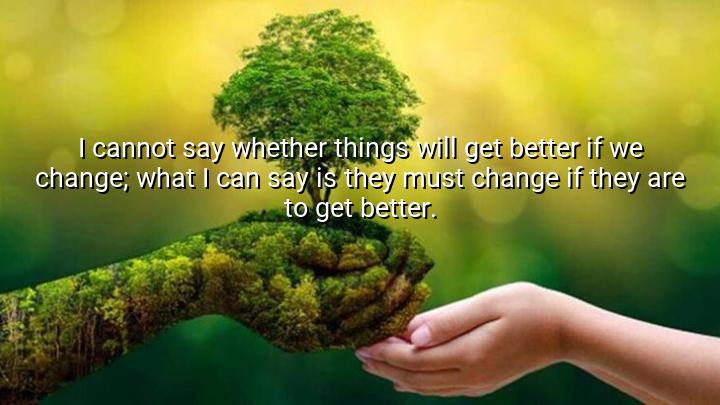




The quote by Georg C. Lichtenberg, "I cannot say whether things will get better if we change; what I can say is they must change if they are to get better," emphasizes the necessity of change for any potential improvement. Lichtenberg acknowledges the uncertainty of outcomes but firmly asserts that without change, progress or betterment is impossible. This perspective encourages taking action despite the unknown, as stagnation guarantees no positive development.
The origin of this quote comes from Georg Christoph Lichtenberg, an 18th-century German scientist, satirist, and philosopher known for his sharp wit and insights into human nature. His writings often explored the complexities of life, knowledge, and progress. This quote reflects his pragmatic view that while change doesn’t promise success, it is an essential prerequisite for growth and improvement.
This quote also highlights the tension between risk and reward inherent in the process of change. Lichtenberg’s words encourage embracing uncertainty as part of the journey toward better outcomes. It’s a call to overcome fear of change and to understand that doing nothing is a guaranteed barrier to improvement.
In essence, Georg C. Lichtenberg’s quote inspires a courageous approach to life, urging us to accept change as a necessary step toward growth. His message reminds us that while change may not always lead to immediate results, it is the only path to potential progress.

AAdministratorAdministrator
Welcome, honored guests. Please leave a comment, we will respond soon