

I am positive that I would see the end of child labour around the world in my lifetime, as the poorest of the poor have realised that education is a tool that can empower them.
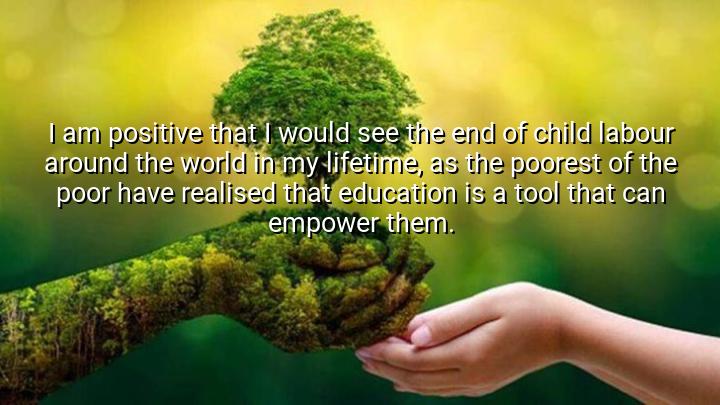




Kailash Satyarthi’s quote, “I am positive that I would see the end of child labour around the world in my lifetime, as the poorest of the poor have realised that education is a tool that can empower them,” conveys his deep optimism and commitment to social justice. He believes that the eradication of child labour is possible when families recognize the transformative power of education, which opens doors to opportunity and dignity. His words highlight a hopeful vision of a world where children are free from exploitation.
The meaning of this quote lies in linking education to liberation. Satyarthi emphasizes that child labour persists largely due to poverty, but when impoverished communities come to see education as a means of empowerment, they begin to resist systems that exploit their children. By choosing schooling over labour, families not only protect their children’s rights but also create pathways for breaking cycles of poverty.
The origin of this perspective is rooted in Satyarthi’s lifelong activism. As an Indian Nobel Peace Prize laureate and founder of the Bachpan Bachao Andolan (Save the Childhood Movement), he has rescued tens of thousands of children from child labour and slavery. His work has consistently demonstrated that access to education is the most effective antidote to exploitation, giving children the chance to reclaim their futures.
Ultimately, Satyarthi’s words are both a declaration of hope and a call to action. By framing education as the tool of empowerment, he underscores that ending child labour is not just a dream but a realistic goal, achievable through collective effort. His vision inspires global movements to ensure that every child enjoys freedom, dignity, and the opportunity to learn.

AAdministratorAdministrator
Welcome, honored guests. Please leave a comment, we will respond soon