

I am not made for politics because I am incapable of wanting or accepting the death of the adversary.
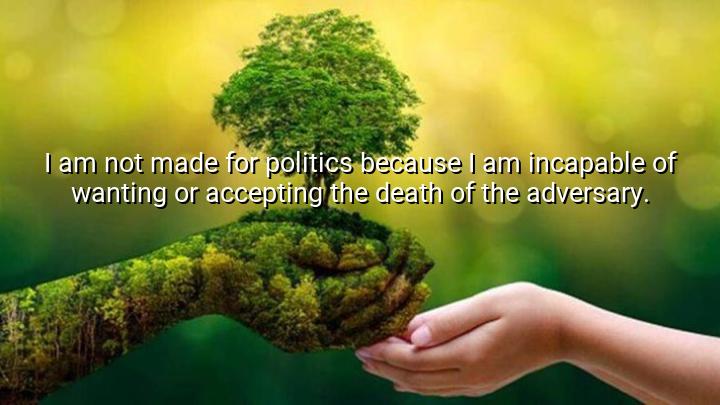




In this quote, Albert Camus, a French philosopher and writer, reflects on his personal inability to engage in politics due to his moral stance. He suggests that politics, especially at its extreme, often involves a sense of opposition where the defeat of an adversary can lead to their destruction, either metaphorically or literally. Camus acknowledges his incapacity to desire or accept the death of his opponent, implying that his personal ethics conflict with the often harsh and ruthless nature of political struggles.
Camus’ words speak to his philosophy of absurdism, which highlights the tension between human desire for meaning and the inherent meaninglessness of the universe. He believed that individuals should confront the absurdity of life without resorting to violence or moral compromise. His refusal to accept the death of an adversary reflects his commitment to human dignity and his belief that political conflict should not involve personal animosity or the elimination of the opposition.
The quote also underscores Camus’ rejection of totalitarian or ideologically driven political systems, where the annihilation of an opponent is often seen as justified in the name of ideological purity or victory. By stating his inability to accept such violence, Camus sets himself apart from political figures who view the defeat of the adversary as a necessary part of gaining power or maintaining control. His moral and philosophical beliefs prioritize humanity and the value of life, regardless of political differences.
Originating from Albert Camus, a key figure in 20th-century philosophy and literature, this quote reflects his commitment to the principles of individualism, humanism, and ethics. Camus was known for his resistance to political ideologies that justified violence or the loss of individual freedom in the pursuit of a greater goal. Through this quote, he offers a powerful critique of politics that values victory at any cost, advocating instead for a more humane approach to conflict and adversity.

AAdministratorAdministrator
Welcome, honored guests. Please leave a comment, we will respond soon