

How did the economy produce all these amazing things that we have around us - computers and cell phones and so on? There were a bunch of ideas, and the good ones grew and prospered. And the bad ones were pretty ruthlessly weeded out.
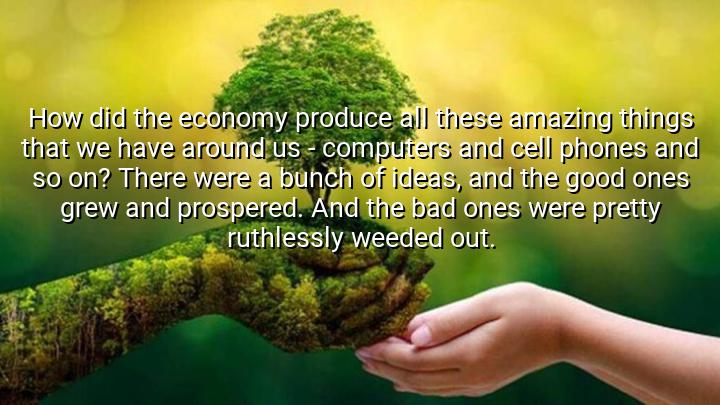




In this quote, Tim Harford reflects on the dynamic nature of the economy and the process by which technological innovations like computers and cell phones have come to shape our world. Harford emphasizes that these advancements are the result of a multitude of ideas, where the most successful ones "grew and prospered," while the less effective or flawed ideas were "ruthlessly weeded out." This highlights the competitive and adaptive nature of the market, where only the most viable and useful innovations survive and thrive.
Harford's statement underscores the role of innovation and competition in driving economic growth. In a market economy, ideas are constantly being tested and refined, and those that offer significant value or efficiency tend to prevail. The bad ideas that fail to meet the demands of consumers or do not function effectively are discarded, allowing for a continuous cycle of progress. This process of natural selection in the economy fosters the development of products and technologies that improve our daily lives.
The quote also alludes to the importance of entrepreneurship and failure in the innovation process. Not every idea is a success, but through experimentation, failure is often necessary for finding what works. Harford acknowledges that while not every innovation will succeed, the economy provides the environment where the best ideas can be nurtured, scaled, and brought to the forefront, creating a ripple effect of progress and development in technology.
Ultimately, Harford’s quote highlights the powerful interplay between ideas, competition, and economic forces in shaping technological progress. It points to the ruthlessness of the market in filtering out unworkable ideas and allowing only the most viable and beneficial innovations to flourish, ultimately shaping the world around us with tools like computers and cell phones.

AAdministratorAdministrator
Welcome, honored guests. Please leave a comment, we will respond soon