

He who rejects change is the architect of decay. The only human institution which rejects progress is the cemetery.
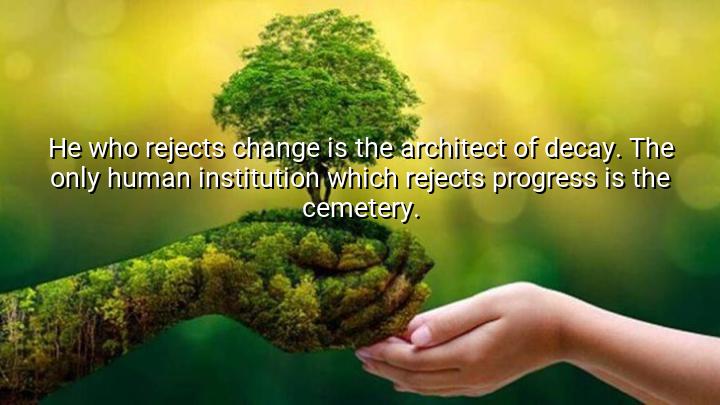




The quote by Harold Wilson, "He who rejects change is the architect of decay. The only human institution which rejects progress is the cemetery," emphasizes the critical importance of embracing change and progress for growth and survival. Wilson warns that resisting change leads to stagnation and eventual decline, highlighting that progress is essential for any thriving institution or society. The metaphor of the cemetery symbolizes the ultimate rejection of change—death—reminding us that without adaptation, decay is inevitable.
The origin of this quote is rooted in Wilson’s career as a British politician and Prime Minister during times of significant social and economic transformation. His leadership was marked by efforts to modernize and reform institutions, and this quote reflects his belief that progress and openness to change are necessary to avoid obsolescence. It serves as a powerful statement on the need for continuous evolution in both personal and collective contexts.
This quote also underscores the universal truth that change is an unavoidable and vital part of life. While some may fear or resist it, Wilson encourages us to see change as an opportunity for improvement rather than a threat. His words challenge complacency and inspire proactive adaptation to new realities.
In essence, Harold Wilson’s quote reminds us that resisting change leads to decline, while embracing progress is key to vitality and success. It serves as a timeless call to remain open, adaptable, and forward-thinking in the face of inevitable transformation.

AAdministratorAdministrator
Welcome, honored guests. Please leave a comment, we will respond soon