

God the Father and God the Son cannot be everywhere present; indeed they cannot be even in two places at the same instant: but God the Holy Spirit is omnipresent - it extends through all space, with all other matter.
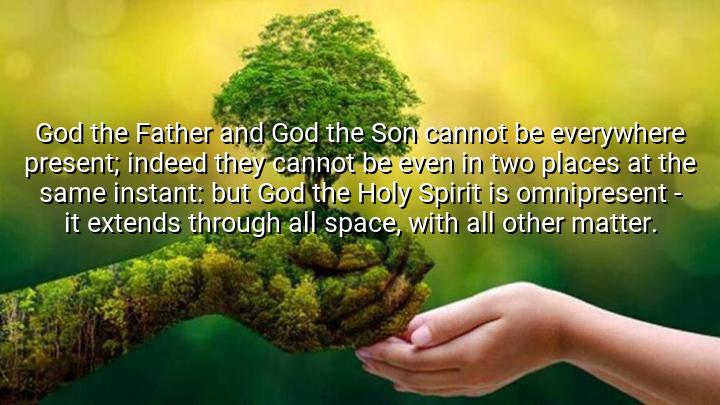




The quote "God the Father and God the Son cannot be everywhere present; indeed they cannot be even in two places at the same instant: but God the Holy Spirit is omnipresent - it extends through all space, with all other matter" by Orson Pratt reflects a theological explanation of the nature of the Holy Spirit within Christian doctrine. Pratt suggests that, unlike the Father and the Son, who are understood to have physical forms and, therefore, cannot be in multiple places at once, the Holy Spirit is not limited by physical constraints and is present throughout all of creation. Omnipresence is a defining characteristic of the Holy Spirit, allowing it to be present everywhere simultaneously.
Pratt’s distinction between the Father, the Son, and the Holy Spirit reflects a belief in the Trinity, the Christian doctrine that defines God as three persons in one essence. While the Father and the Son are considered distinct and separate in terms of their divine roles and functions, the Holy Spirit is described as the ever-present force that interacts with the world and God's creation in a way that transcends physical limitations. The notion of omnipresence implies that the Holy Spirit is always available, interacting with the physical universe, and can influence all things at once.
The origin of this quote comes from Orson Pratt, an influential early leader in The Church of Jesus Christ of Latter-day Saints (LDS), whose theological writings often sought to explain and clarify aspects of the Trinity and the nature of God. Pratt was known for his emphasis on doctrinal clarity and his efforts to reconcile traditional Christian teachings with those of the LDS faith. His belief in the distinct roles of the Father, Son, and Holy Spirit in the Godhead is evident in this quote, particularly in his view that the Holy Spirit's omnipresence enables it to fill the world and interact with all of creation in a unique way.
Ultimately, Pratt's quote seeks to underscore the unique nature of the Holy Spirit in the divine framework. By describing the Holy Spirit as omnipresent, Pratt emphasizes its power and ability to be present everywhere, unlike the Father and the Son, whose roles in creation are more specific and bound by the concept of physical presence. This explanation helps to illustrate the profound theological distinction between the persons of the Trinity, while highlighting the Holy Spirit’s pervasive, all-encompassing presence in the world.

AAdministratorAdministrator
Welcome, honored guests. Please leave a comment, we will respond soon