

God is a metaphor for that which transcends all levels of intellectual thought. It's as simple as that.
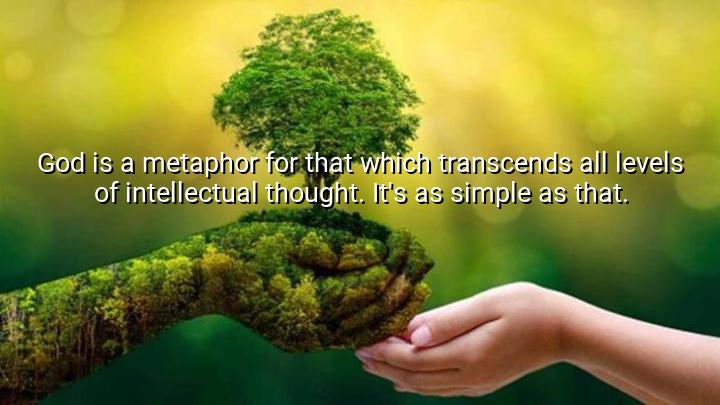




The quote by Joseph Campbell, "God is a metaphor for that which transcends all levels of intellectual thought. It's as simple as that," reflects his belief that God is not a concrete, intellectual concept to be fully understood or explained but rather a metaphor for the profound mysteries that surpass human comprehension. Campbell, a renowned mythologist and scholar, suggests that the divine cannot be grasped through reason or intellectual analysis alone. Instead, God represents something beyond the limits of human thought, an experience or truth that cannot be reduced to simple definitions or rational explanations.
Campbell's statement emphasizes the mystical and transcendent nature of God. He viewed religious and spiritual symbols, including God, as vehicles for accessing deeper truths and experiences that lie beyond the boundaries of the intellect. The divine, in Campbell’s view, serves as a metaphor for ultimate reality—an experience that goes beyond what can be easily understood, categorized, or articulated by the human mind. This perspective aligns with Campbell's broader work, where he often explored how myths and religious stories reflect universal human experiences that cannot always be captured in logical or analytical terms.
The origin of this quote lies in Joseph Campbell’s work on mythology and spirituality, where he frequently explored the symbolic nature of religious concepts. His studies focused on the common themes found in myths across cultures, suggesting that many of the world’s religions and spiritual beliefs are symbolic expressions of universal human experiences. Campbell’s understanding of God as a metaphor reflects his approach to the study of religion, which emphasized the importance of symbolic meanings over literal interpretations.
Ultimately, Campbell’s quote encourages a more intuitive and experiential approach to understanding the divine. Instead of trying to intellectually analyze or define God, he suggests that we should recognize God as a symbol or metaphor for the mystical and transcendent aspects of life that defy complete explanation. This view invites people to explore their spirituality through experience and symbolic meaning, rather than through rigid intellectual frameworks.

AAdministratorAdministrator
Welcome, honored guests. Please leave a comment, we will respond soon