

God, I can push the grass apart and lay my finger on Thy heart.
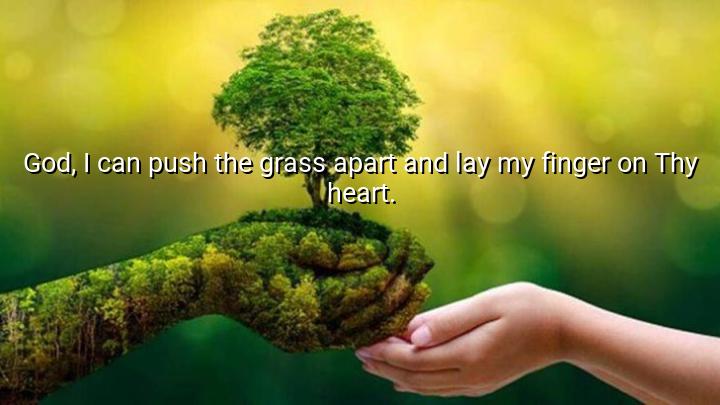




In this quote, Edna St. Vincent Millay, an American poet, expresses a deep, intimate connection with God and nature. The line "I can push the grass apart and lay my finger on Thy heart" suggests that through a simple, physical act of touching nature, the speaker feels a profound spiritual connection with the divine. By engaging with the natural world, she believes she can directly touch the heart of God, symbolizing a moment of closeness and unity with the divine presence.
Millay’s use of grass in the imagery conveys the idea that the divine can be found in the simplest, most accessible aspects of life, rather than in grand or distant spiritual experiences. This idea reflects a belief in the immanence of God, meaning that the divine is present in all things, even in the humble and earthly elements of nature. Through the tactile experience of pushing the grass apart, Millay connects the physical with the spiritual, suggesting that God is near and accessible, not hidden in some far-off realm.
The phrase also evokes a sense of personal intimacy and reverence. By saying she can "lay my finger on Thy heart," Millay implies a direct and personal relationship with God, one where the divine is not distant or abstract but something that can be touched and felt in a very real, tangible way. This conveys the idea that spirituality is not just about doctrine or distant worship but about experiencing the divine in everyday life.
Ultimately, Millay’s quote highlights the theme of spiritual connection through the natural world, suggesting that God is present not just in sacred spaces but in all of creation. It invites the reader to see divinity in the small, seemingly mundane aspects of life and reminds us of the closeness and intimacy that can exist between humans and the divine.

AAdministratorAdministrator
Welcome, honored guests. Please leave a comment, we will respond soon