

God has given you one face, and you make yourself another.
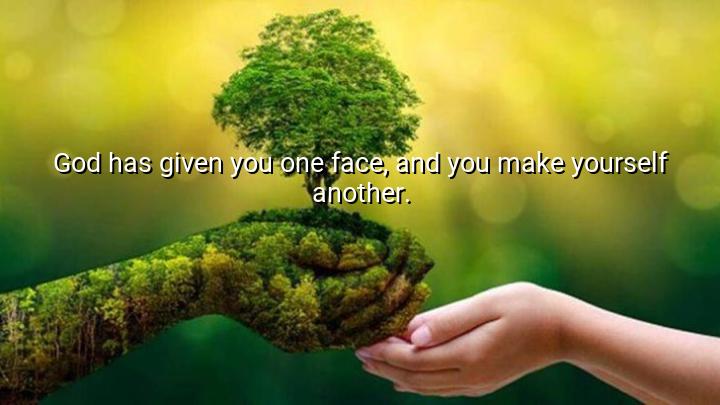




The quote "God has given you one face, and you make yourself another" by William Shakespeare reflects on the tension between authenticity and pretense. Shakespeare is suggesting that God has created each person with a natural identity, yet humans often choose to hide or alter this true self in favor of a constructed persona. This can be interpreted as a comment on the way people often wear metaphorical masks to conform to societal expectations or to protect themselves from vulnerability, rather than embracing their genuine nature.
The origin of this quote comes from Shakespeare’s play Hamlet, where it is spoken by Polonius in Act 3, Scene 1. In the context of the play, Polonius is offering advice to his son, Laertes, about how to behave in the world. The quote serves as a warning to avoid deceitful behavior or hypocrisy, urging Laertes to stay true to his inner self rather than putting on a false face for the sake of appearances. Shakespeare uses this line to explore themes of identity, self-deception, and the dangers of living inauthentically.
The quote emphasizes the idea that God created people in their most true and pure form, and it is the choices they make—whether due to fear, societal pressures, or vanity—that lead them to create false identities. This serves as a critique of human nature, especially the tendency to act in ways that contradict one's true feelings or values. Shakespeare seems to suggest that the more a person masks their true self, the further they distance themselves from their divine purpose and inner truth.
Ultimately, Shakespeare’s message is a reflection on the importance of authenticity and the consequences of failing to live in alignment with one’s true self. By recognizing that the face given by God is the one that should be embraced, the quote encourages individuals to cultivate honesty and integrity, both with themselves and others, rather than hiding behind a façade. It calls for a life lived with genuine expression, free from the constraints of pretense or societal expectations.

AAdministratorAdministrator
Welcome, honored guests. Please leave a comment, we will respond soon