

For some time, I thought Apollo 13 was a failure. I was disappointed I didn't get to land on the moon. But actually, it turned out to be the best thing that could have happened.
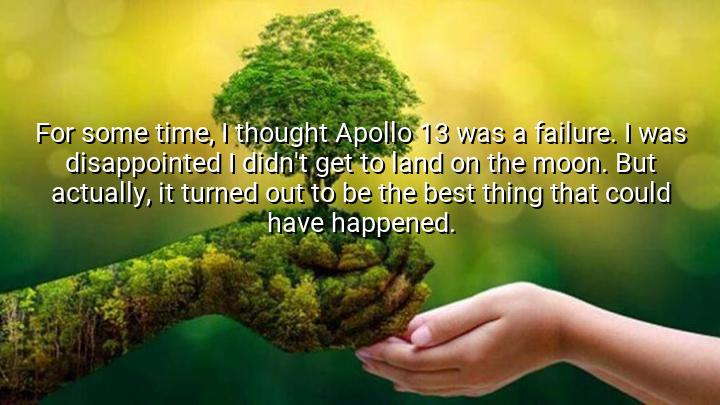




In this quote, Jim Lovell reflects on his initial perception of the Apollo 13 mission as a failure. As one of the astronauts on the mission, Lovell initially felt disappointed that the team was unable to land on the moon, which was the primary goal of the Apollo missions. The setback seemed like a significant personal and professional defeat, as landing on the moon had been a key objective of the Apollo program and a historic aspiration for him and his crew.
However, Lovell later came to realize that what initially seemed like a failure was actually one of the most important and successful aspects of the Apollo 13 mission. The mission, which experienced a life-threatening crisis when an oxygen tank exploded, ended up being a remarkable success in terms of problem-solving, teamwork, and survival. The crew, along with mission control, worked tirelessly to find creative solutions to bring them back safely to Earth, showcasing the ingenuity and resilience of all involved.
Lovell’s change in perspective highlights the idea that success and failure are not always clear-cut. Sometimes, what appears to be a failure can lead to greater outcomes, like the Apollo 13 mission, which became a symbol of overcoming adversity and the capabilities of human perseverance. The experience ultimately demonstrated that even when things go wrong, the ability to adapt and find solutions can make an even greater impact.
In essence, Lovell’s reflection serves as a powerful reminder that failure is often not the end but a turning point that can lead to unexpected success. His experience with Apollo 13 shows how initial setbacks can lead to growth, innovation, and valuable lessons, making the mission one of the most celebrated in the history of space exploration, even though it didn’t achieve its original goal.

AAdministratorAdministrator
Welcome, honored guests. Please leave a comment, we will respond soon