

Feeling is the consciousness of the resulting conditions - of success, failure, equilibrium, compromise or balance, in this continuous rivalry of ideas.
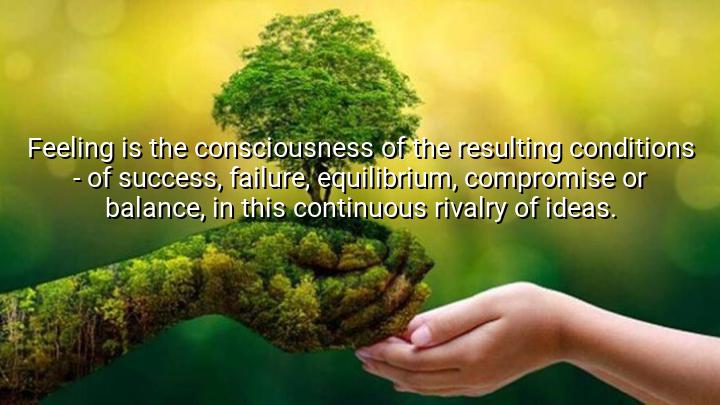




The quote "Feeling is the consciousness of the resulting conditions - of success, failure, equilibrium, compromise or balance, in this continuous rivalry of ideas." by James Mark Baldwin explores the complex relationship between emotion and cognition in the process of intellectual and personal development. Baldwin suggests that feelings arise as an awareness or consciousness of outcomes—whether they be success, failure, or states of balance—that result from the ongoing struggle between competing ideas or viewpoints. This perspective highlights the idea that emotions are deeply connected to the way we interpret and navigate conflicts and resolutions.
James Mark Baldwin, a prominent psychologist and philosopher, was interested in how human beings grow and learn through the dynamic interaction of ideas. This quote reflects his belief that feelings are not random but are meaningful responses that provide insight into the state of mental or social equilibrium. The "continuous rivalry of ideas" represents the constant tension and negotiation that shape thought and behavior, with feelings serving as indicators of where one stands in this process.
The origin of this quote is likely found in Baldwin’s works on psychology and philosophy from the late 19th or early 20th century, where he analyzed the interplay between thought, emotion, and social interaction. His insights laid the groundwork for later theories on emotional intelligence and cognitive development, emphasizing how feelings help guide decision-making and learning.
In summary, James Mark Baldwin’s quote highlights the role of feelings as conscious markers of the outcomes of intellectual and emotional conflicts. It suggests that emotions are integral to understanding and managing the ongoing challenges of balancing ideas, ultimately contributing to personal growth and adaptation.

AAdministratorAdministrator
Welcome, honored guests. Please leave a comment, we will respond soon