

Faith is the sense of life, that sense by virtue of which man does not destroy himself, but continues to live on. It is the force whereby we live.
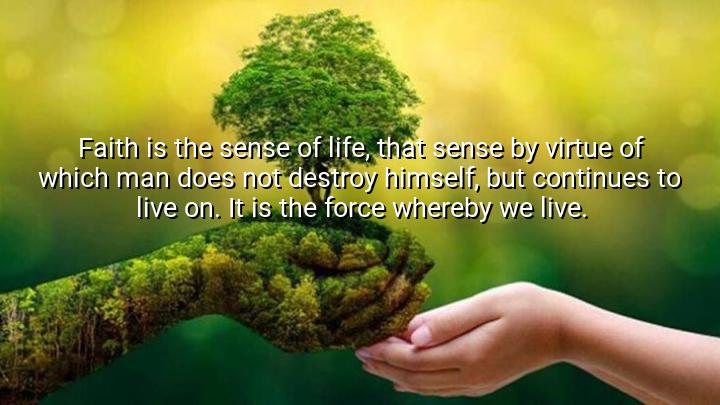




The quote "Faith is the sense of life, that sense by virtue of which man does not destroy himself, but continues to live on. It is the force whereby we live." by Leo Tolstoy delves into the profound role of faith as an essential and sustaining element of human existence. Tolstoy portrays faith not simply as a religious belief, but as the inner force that gives life meaning, direction, and endurance. It is, according to him, the very "sense of life"—a deep, intuitive awareness that life is worth living, even amid suffering or uncertainty.
The phrase "does not destroy himself, but continues to live on" highlights the existential weight of faith. Tolstoy suggests that without it, a person may fall into despair, unable to find purpose or withstand the hardships of life. In this view, faith is the barrier between hopelessness and the will to continue—it empowers individuals to move forward, trust in something greater than themselves, and find hope in the unseen or unknown.
Tolstoy, a Russian novelist and moral philosopher best known for War and Peace and Anna Karenina, underwent a spiritual crisis later in life, which led him to write extensively about religion, meaning, and morality. This quote is rooted in that phase of his life, particularly reflected in his work A Confession, where he explores the emptiness he felt despite material success, and how he rediscovered purpose through a renewed faith in God and the moral order.
Ultimately, the quote presents faith as the lifeblood of the soul—an invisible yet vital force that anchors us to life itself. Tolstoy's words remind us that in the face of life’s greatest uncertainties, it is faith—in ourselves, in others, or in something higher—that sustains the human spirit and keeps us pressing onward.

AAdministratorAdministrator
Welcome, honored guests. Please leave a comment, we will respond soon