

Failure is good. It's fertilizer. Everything I've learned about coaching, I've learned from making mistakes.
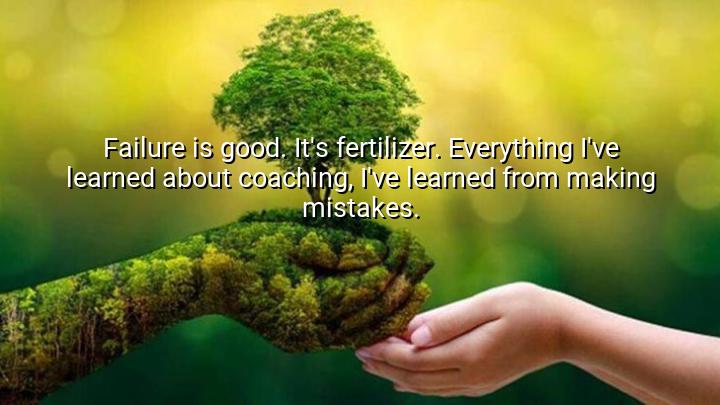




In this quote, Rick Pitino shares his perspective on failure and its importance in personal and professional growth. He refers to failure as fertilizer, suggesting that just as fertilizer nourishes the soil and helps plants grow, failure nourishes our ability to learn and improve. Pitino emphasizes that failure is not something to be feared or avoided but rather embraced as an essential part of the learning process.
Pitino's statement also underscores the value of mistakes in the context of coaching and leadership. He acknowledges that everything he has learned about coaching comes from his own errors, highlighting how setbacks and challenges provide valuable lessons. This mindset is crucial in high-stakes environments like coaching, where the ability to adapt and grow from failures can ultimately lead to long-term success.
The quote reflects resilience and growth, as Pitino suggests that failure is not the end of the road but a step toward improvement. It’s about how one responds to failure—by reflecting on it, learning from it, and using it as an opportunity to develop new skills and insights. Pitino’s approach advocates for self-awareness and continuous improvement.
Ultimately, Pitino’s perspective on failure encourages a shift in how we view setbacks in both personal and professional life. Instead of seeing failure as something negative, he encourages us to view it as a necessary part of the process that leads to growth, learning, and eventual success. His quote highlights the transformative power of mistakes and how they can help build the foundation for future achievements.

AAdministratorAdministrator
Welcome, honored guests. Please leave a comment, we will respond soon