

Experience has shown, and a true philosophy will always show, that a vast, perhaps the larger portion of the truth arises from the seemingly irrelevant.
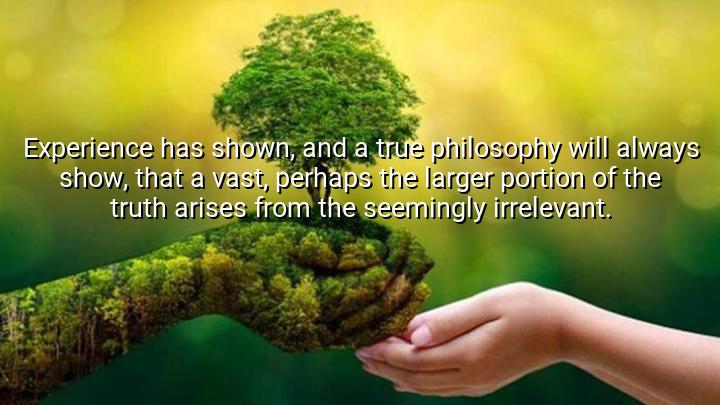




In this quote, Edgar Allan Poe suggests that truth is often found in places that may seem insignificant or irrelevant at first glance. He emphasizes that a true philosophy—one that seeks to understand the deeper nature of reality—will reveal that many important insights arise from things that may not initially seem to matter. By pointing out that the larger portion of truth can come from the seemingly insignificant, Poe challenges the conventional belief that only the most obvious or direct observations lead to profound understanding.
Poe’s statement also reflects the idea that the unnoticed or overlooked aspects of life often contain deeper meanings that may be more revealing than what is immediately apparent. It aligns with his interest in exploring the complexities of the human mind and how seemingly trivial details can contribute to a greater understanding of the self and the world. This view invites individuals to pay attention to the subtle and hidden aspects of life, as they may offer valuable insights that are often dismissed.
The origin of this quote connects to Poe’s broader philosophy and approach to writing, which often dealt with themes of mystery, psychology, and perception. As a writer of gothic fiction and poetry, Poe was deeply interested in how the mind interprets reality, and how small, overlooked details can have profound implications. His works, like The Tell-Tale Heart and The Fall of the House of Usher, illustrate this idea by focusing on seemingly minor details that turn out to be central to the narrative's deeper meaning.
Ultimately, Poe’s quote encourages us to rethink how we perceive truth and meaning. Instead of focusing solely on what seems important, he invites us to consider the overlooked aspects of life, as they often contain hidden truths that are essential to a more complete understanding of the world. It’s a reminder that wisdom and insight are not always found in the obvious or conventional, but in the small, seemingly irrelevant moments and details that make up our experiences.

AAdministratorAdministrator
Welcome, honored guests. Please leave a comment, we will respond soon