

Emigration, forced or chosen, across national frontiers or from village to metropolis, is the quintessential experience of our time.
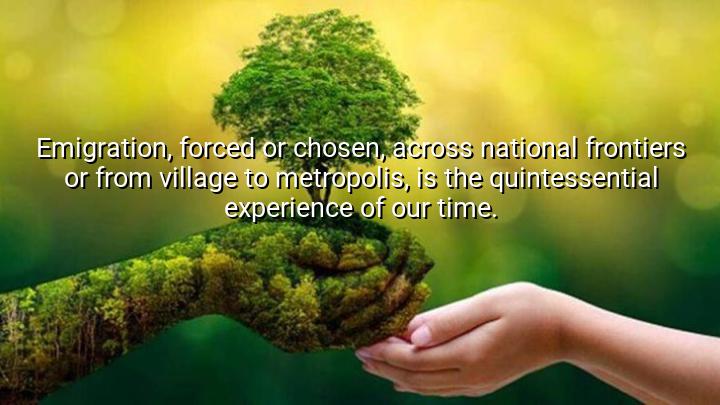




In the quote by John Berger, "Emigration, forced or chosen, across national frontiers or from village to metropolis, is the quintessential experience of our time," Berger addresses the pervasive and transformative nature of emigration in the modern world. He highlights the fact that people are constantly moving—whether voluntarily or involuntarily—across national frontiers or from rural areas to bustling urban centers. This migration, in all its forms, has become a defining characteristic of contemporary life. Berger sees it as a universal experience that shapes both individual lives and broader societal dynamics.
The origin of this quote reflects Berger's perspective as an art critic, essayist, and philosopher, where he often examined the intersection of culture, identity, and modern society. His works frequently address the effects of displacement, migration, and how the flow of people influences both the personal and collective experience. In this quote, Berger speaks to the increasing global movement of populations, whether due to economic necessity, political conflict, or the search for better opportunities.
By describing emigration as the quintessential experience, Berger suggests that migration is a central theme of the modern era, affecting individuals and societies in profound ways. It reflects both personal stories of adaptation and the larger societal forces at play, such as globalization and urbanization. Whether someone moves from a small village to a large metropolis or is forced to flee their homeland due to conflict, emigration fundamentally alters both the individual and the community.
Ultimately, Berger's quote captures the complexity of migration as a phenomenon that is not only shaped by necessity but also driven by the search for new possibilities. As a result, emigration becomes a key element in understanding the modern human condition, embodying the struggles, opportunities, and transformations that come with leaving one place for another.

AAdministratorAdministrator
Welcome, honored guests. Please leave a comment, we will respond soon