

Death? Why this fuss about death? Use your imagination, try to visualize a world without death! Death is the essential condition of life, not an evil.
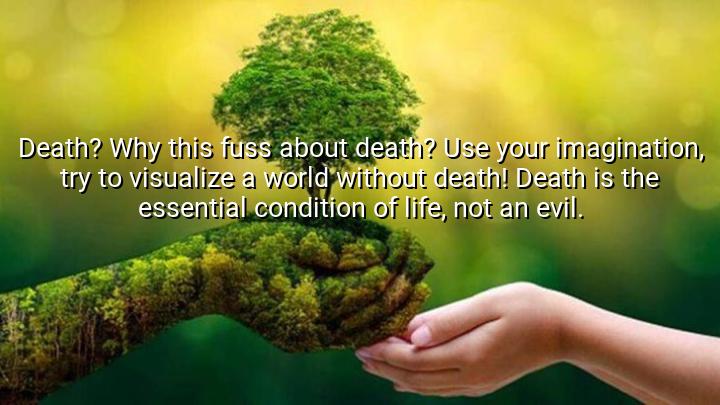




In this quote, Charlotte Perkins Gilman challenges the common perception of death as something to be feared or avoided. She questions why so much fuss is made about death, urging people to use their imagination and envision a world where death does not exist. By doing this, Gilman suggests that death is not inherently evil or something to be dreaded, but rather an essential condition of life. Without it, she implies, life would lose its meaning, urgency, and value, as death gives life its contrast and impermanence.
Gilman’s perspective invites us to reconsider how we view death and life. She asserts that rather than seeing death as a negative force, we should recognize it as a natural part of the life cycle. The idea that death is not an evil, but an integral part of what makes life possible, challenges traditional views of mortality and encourages a more philosophical and accepting approach to human existence. By imagining a world without death, Gilman highlights that life’s preciousness and meaning stem from its temporary nature.
The origin of this quote is rooted in Gilman’s work as a social reformer, feminist, and writer. Known for her advocacy of women’s rights and progressive social views, Gilman often questioned traditional norms and perceptions, urging society to adopt new ways of thinking. This quote reflects her broader philosophical approach, which encouraged people to challenge conventional wisdom and embrace more enlightened, open-minded views about life and its realities.
Ultimately, Gilman’s quote encourages a shift in how we view death and life. By promoting the idea that death is not an evil but an essential condition of life, she calls for a greater acceptance of mortality and a deeper appreciation of the finite nature of human existence. Through imagination, we can understand death not as something to be feared but as a natural part of the cycle that makes life more valuable.

AAdministratorAdministrator
Welcome, honored guests. Please leave a comment, we will respond soon