

Only as we live, think, feel, and work outside the home, do we become humanly developed, civilized, socialized.
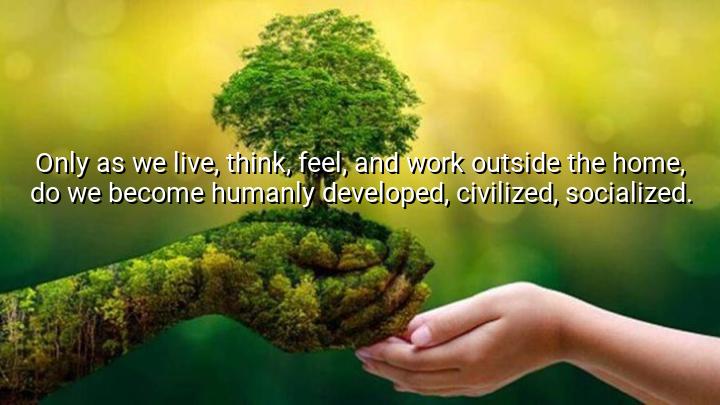




The quote "Only as we live, think, feel, and work outside the home, do we become humanly developed, civilized, socialized." by Charlotte Perkins Gilman explores the idea that true personal development and socialization occur outside the confines of the home. Gilman suggests that while the home is essential for providing basic support and care, it is through engaging with the outside world—whether through work, social activities, or intellectual pursuits—that we grow into fully realized, civilized, and social beings. The quote underscores the importance of external engagement in the formation of one’s identity and role in society.
Gilman’s words also reflect a critique of traditional gender roles, particularly the idea that women’s roles were often confined to the domestic sphere. At the time she wrote, women were largely expected to focus on the home, and Gilman believed this limited their personal development and contribution to society. Her statement advocates for a more liberated and active role for individuals, especially women, in the public sphere, suggesting that work and social interaction are crucial for growth and empowerment.
The origin of this quote lies in Gilman’s feminist writings and her advocacy for women’s rights. Gilman, best known for her work The Yellow Wallpaper, often explored themes related to women’s independence and the social structures that restricted their autonomy. This quote reflects her belief that true progress and human flourishing can only be achieved when individuals are allowed to participate fully in society, both intellectually and economically, beyond just their roles within the home.
Ultimately, Gilman’s quote calls attention to the significance of external experiences—those that take place in the broader world outside the home—as vital to personal and social development. It advocates for a vision of society where everyone, regardless of gender, is given the opportunity to grow and contribute in meaningful ways outside traditional domestic spaces. This idea has had a lasting impact on feminist thought and the ongoing fight for gender equality in public life.

AAdministratorAdministrator
Welcome, honored guests. Please leave a comment, we will respond soon