

Death most resembles a prophet who is without honor in his own land or a poet who is a stranger among his people.
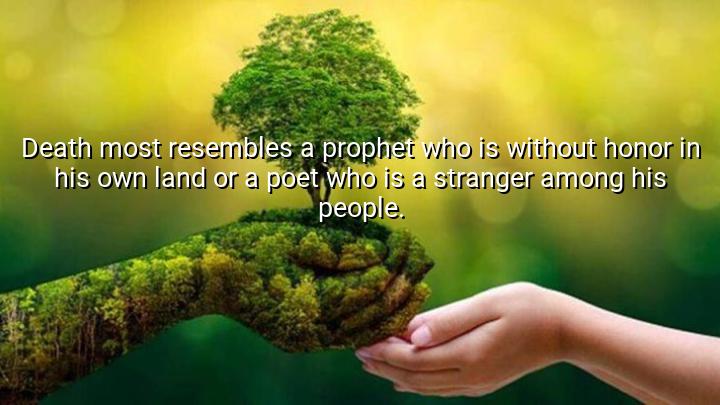




The quote "Death most resembles a prophet who is without honor in his own land or a poet who is a stranger among his people" by Khalil Gibran explores the theme of misunderstanding and neglect, particularly in relation to death and human perception. Gibran, a Lebanese-American poet and philosopher, often reflected on the mysteries of life, death, and the human spirit. In this quote, he compares death to a prophet or a poet—figures who may be revered elsewhere but often face rejection or a lack of recognition in their own environment. This highlights how death, like a prophet or poet, can be ignored or dismissed by those closest to it, often only being truly understood when it's too late.
The origin of this quote reflects Gibran’s deep philosophical view of life and death, where he frequently grappled with the disconnect between human existence and the natural order of life. The comparison of death to a prophet or poet emphasizes how both are often misunderstood in their time, and only later do people come to appreciate or understand their significance. Just as a prophet’s wisdom might go unrecognized in their lifetime, death, too, is often perceived as something to avoid or deny until it becomes undeniable.
Gibran’s reference to death as a prophet without honor underscores the human tendency to overlook or fear the inevitability of death until it directly affects us. Similarly, the comparison to a poet being a stranger among their own people suggests how profound ideas or truths, especially about life and death, are often overlooked by society until they are confronted in a personal, inevitable way. This serves as a critique of how society tends to disregard the deeper aspects of existence until they are forced to face them.
Ultimately, Gibran’s quote reflects on the alienation of death in human consciousness. It calls attention to how we often treat the idea of death with neglect or denial, failing to honor its inevitable place in our lives. By comparing death to a prophet or a poet, Gibran encourages us to reflect on how we engage with the realities of life and death, suggesting that we should acknowledge and honor these truths rather than shying away from them.

AAdministratorAdministrator
Welcome, honored guests. Please leave a comment, we will respond soon