

Death means change our clothes. Clothes become old, then time to come change. So this body become old, and then time come, take young body.
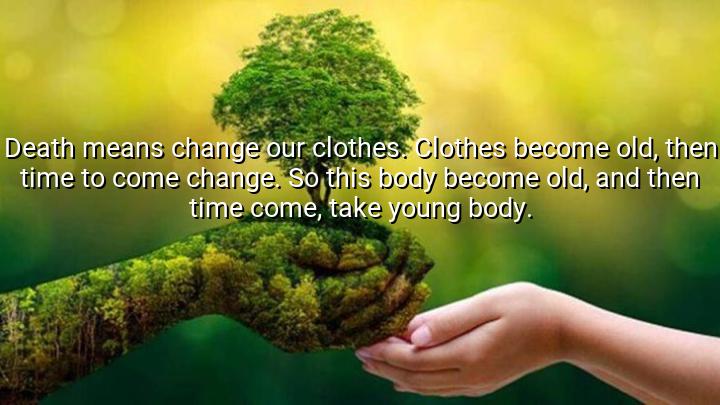




The Dalai Lama’s quote, “Death means change our clothes. Clothes become old, then time to come change. So this body become old, and then time come, take young body,” uses a metaphor to express a spiritual perspective on death and rebirth. By comparing the body to clothing, the Dalai Lama suggests that the soul or consciousness is distinct from the physical body. Just as we discard worn-out garments, we leave behind the aging body when it can no longer serve us, moving on to a new form in the cycle of life.
This quote is rooted in the Buddhist belief in reincarnation—the idea that death is not an end, but a transition to another life. The body is seen as temporary and ever-changing, while the essence of the individual continues its journey. The analogy of changing clothes reflects the impermanence of physical existence, a core teaching in Buddhism that encourages detachment from the material and a focus on spiritual growth.
The Dalai Lama’s words also provide a comforting view of death, presenting it not as something to fear, but as a natural part of existence. By framing death as simply changing into something new, he invites people to see it as an evolution, not a loss. This way of thinking promotes peace of mind and a broader understanding of the life cycle, encouraging acceptance rather than resistance.
The origin of this quote is grounded in the Dalai Lama’s lifelong teachings on compassion, impermanence, and spiritual continuity. As the spiritual leader of Tibetan Buddhism, he often conveys complex ideas through simple, accessible language and imagery. This metaphor of changing clothes allows listeners of all backgrounds to grasp a deep and timeless truth about the nature of life, death, and renewal.

AAdministratorAdministrator
Welcome, honored guests. Please leave a comment, we will respond soon