

Death is the veil which those who live call life; They sleep, and it is lifted.
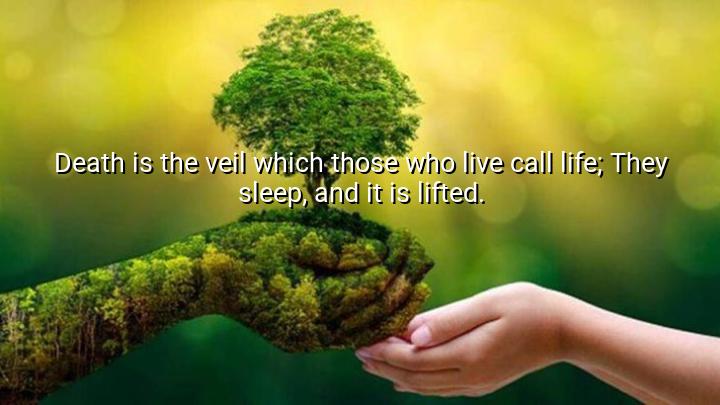




The quote "Death is the veil which those who live call life; They sleep, and it is lifted." by Percy Bysshe Shelley reflects his philosophical and romantic view of life and death. Shelley, an English poet known for his works on nature, human existence, and mortality, suggests that death is not an end but rather a veil that obscures a deeper understanding of life. In this context, life is described as a temporary state where humans are metaphorically "asleep," unaware of the deeper truths beyond their immediate experience.
Shelley's use of the term "veil" emphasizes the idea that death separates humans from a clearer vision of existence, as if it is a barrier that clouds our understanding. The phrase "They sleep, and it is lifted" implies that death reveals a more profound reality, akin to awakening from a dream. For Shelley, death is not something to be feared but rather a transition that brings clarity or enlightenment, lifting the veil that limits human perception during life.
The quote also aligns with Shelley’s romantic ideals, where he often explored themes of transcendence and the limits of human perception. In his worldview, death could be seen as a means of achieving a higher state of understanding or spiritual awakening. This interpretation suggests that while living, individuals are in a state of ignorance, and only through death can the true nature of existence be revealed.
Ultimately, Shelley’s quote reflects his belief in the cyclical nature of life and death, where the transition between the two is not an end, but a lifting of limitations. By framing death as a veil, he suggests that the mysteries of existence are only fully understood after passing through it, offering a more profound perspective on the human condition and the eternal nature of life.

AAdministratorAdministrator
Welcome, honored guests. Please leave a comment, we will respond soon